

Precision Metal Components Drives Innovation in Custom Metal Manufacturing
The ability to turn a digital design into a functional metal part within days rather than months has fundamentally changed how products are developed. At the center of this shift lies a category of manufactured parts known as precision metal components. These are not ordinary metal pieces; they are engineered to exact tolerances, often measured in micrometers, and are produced through processes that demand strict control over geometry, material properties, and surface integrity. When rapid prototyping is combined with custom metal processing, these components become the engine of modern product development across aerospace, medical, automotive, robotics, and energy sectors.
Defining Precision Metal Components
Precision metal components are parts manufactured to highly specific dimensional and functional requirements. A bracket for a satellite, a bone screw for orthopedic surgery, a fuel injector nozzle, or a connector in a high-frequency circuit—all of these fall under this category. What distinguishes them is not merely their size or complexity, but the level of accuracy and repeatability required. A deviation of a few thousandths of a millimeter can mean the difference between a safe implant and a failed one, or between a leak-proof seal and a costly recall.
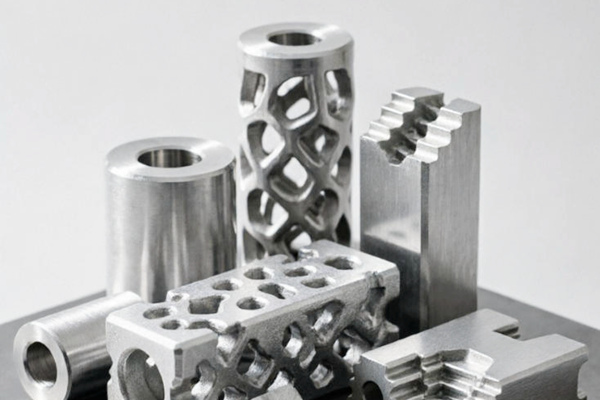
These components are typically produced through CNC machining, metal injection molding, die casting, precision stamping, sheet metal fabrication, or metal additive manufacturing. Each process offers different advantages in terms of cost, speed, material compatibility, and achievable tolerances. The choice depends on the application, production volume, and the stage of product development.
Rapid Prototyping as a Catalyst
Rapid prototyping has removed much of the risk and delay traditionally associated with developing precision metal components. In the past, creating a metal prototype required dedicated tooling, long lead times, and significant capital. Today, technologies such as direct metal laser sintering, binder jetting, and high-speed CNC prototyping allow engineers to hold a functional metal part in their hands within days.
This speed matters because design flaws are cheapest to fix early. A prototype made from the same alloy as the intended production part can be tested for strength, fit, thermal behavior, and wear. Engineers can then iterate rapidly, refining wall thicknesses, fillets, hole placements, and tolerances until the design meets all requirements. In many cases, rapid prototyping also serves as bridge production, supplying initial batches of precision metal components while hard tooling is still being manufactured.
Custom Metal Processing from Prototype to Production
Moving from a prototype to full-scale production requires a thoughtful approach to custom metal processing. A process that works well for one prototype may not scale economically or technically. For example, a part produced by metal additive manufacturing may have different grain structure and fatigue properties than one made by forging or CNC machining.
A successful custom metal processing strategy addresses several key areas. Material selection is critical: stainless steel, titanium, aluminum, brass, copper, and nickel alloys each bring distinct advantages in strength, corrosion resistance, conductivity, or biocompatibility. Process matching ensures that the chosen method aligns with production volume, geometry, and tolerance requirements. Post-processing steps such as heat treatment, anodizing, electroplating, passivation, or precision grinding are often necessary to achieve final specifications. Finally, quality assurance through coordinate measuring machines, optical inspection, and non-destructive testing ensures that every component meets the required standard.
The Convergence of Speed and Precision
The real power of rapid prototyping and custom metal manufacturing lies in their convergence. Digital design files, simulation tools, and automated machining centers allow a single digital thread to connect concept, prototype, and production. This continuity reduces transcription errors, shortens lead times, and makes it economically viable to produce precision metal components in small batches or even one-offs.
Industries such as medical devices benefit enormously. A surgeon-specific instrument can be designed, prototyped, and produced in biocompatible titanium within a week. Aerospace engineers can test a lightweight bracket made from aluminum or titanium alloy before committing to a production run. Automotive teams can validate a transmission component or a heat sink without waiting for expensive tooling.
Conclusion
Precision metal components are far more than machined parts. They are the physical embodiment of engineering intent, and their quality determines the performance, safety, and reliability of the products that depend on them. Rapid prototyping has accelerated their development, while custom metal processing has made it possible to produce them efficiently at any scale. As manufacturing technologies continue to advance, the ability to deliver precise, custom metal components quickly will remain a defining competitive advantage for innovative companies worldwide.




