

Rapid Prototyping Beyond the Enclosure: Adjacent Capabilities in Custom Metal Manufacturing
Rapid prototyping is often discussed as though it begins and ends with the enclosure itself. In practice, the value of a fast manufacturing partner lies in the ecosystem of capabilities surrounding the housing: the brackets, busbars, connectors, thermal hardware, and tooling that turn a sheet metal box into a complete electronic assembly. For design teams working under compressed schedules, these adjacent processes frequently determine whether a prototype ships on time. This article examines the broader landscape of rapid prototyping in custom metal fabrication, focusing on the capabilities that support electronics hardware beyond the enclosure.
Prototyping as an Integrated Workflow
The most effective rapid prototyping programs treat fabrication as a connected sequence rather than a collection of isolated services. A typical electronics program may require laser-cut chassis panels, CNC-machined mounting blocks, stamped contact springs, and turned standoffs, all within a single build. When these parts are produced under one roof, tolerances stack predictably, finishes remain consistent, and assembly fixtures can be designed alongside the components they support. Distributed sourcing, by contrast, introduces coordination overhead and tolerance mismatches that often surface only during final assembly.
CNC Machining for Functional Prototypes
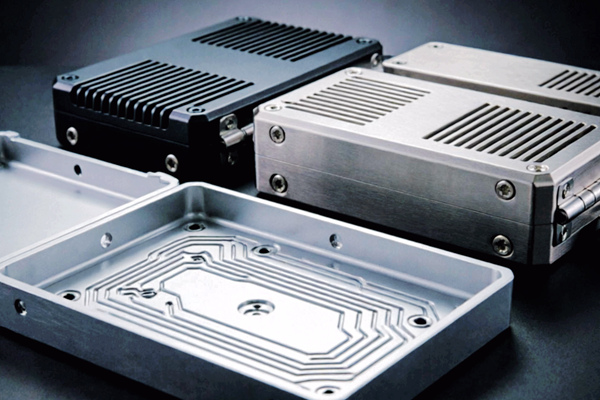
CNC machining remains the backbone of functional prototyping for metal electronics hardware. Beyond enclosures, it produces heat sinks with fin geometries optimized for forced convection, RF shielding cans with precise cavity dimensions, and connector housings with threaded interfaces. Because machining requires no tooling, design revisions can be implemented between runs without penalty. Multi-axis machining further enables contoured surfaces, angled ports, and internal channels for liquid cooling—features that would demand dedicated tooling in a casting process.
Sheet Metal and Stamping for Structural Components
Sheet metal fabrication extends well past the enclosure. Chassis rails, mounting plates, card guides, and EMI gaskets are commonly produced through laser cutting, punching, and forming. Progressive die stamping becomes economical once volumes justify tooling, delivering consistent parts at low unit cost. For prototyping, however, laser cutting and press brake forming offer the flexibility to test multiple revisions quickly. Engineers can evaluate bend relief, springback, and fastener access with real parts before committing to hard tooling.
Turning, Fasteners, and Precision Hardware
Small metal components often carry disproportionate importance. Turned standoffs establish board spacing; custom screws and inserts define serviceability; pins and terminals determine interconnection reliability. Swiss-style turning and CNC lathes produce these parts to tight tolerances in prototype quantities, while secondary operations such as threading, knurling, and plating complete the specification. Overlooking these details during prototyping frequently leads to rework later, when a connector no longer aligns or a fastener bottoms out before the assembly is secure.
Surface Treatment and Finishing
Finishing is both a functional and a cosmetic process. Anodizing improves corrosion resistance and provides a dielectric layer for aluminum housings. Chromate conversion coatings preserve conductivity for grounding paths. Electroless nickel plating offers uniform coverage on complex geometries, while powder coating delivers durability for industrial environments. Laser marking, silkscreening, and chemical etching add part numbers, logos, and orientation marks. In rapid prototyping, finishing choices should be validated early, because a coating that alters thread fit or contact resistance can invalidate an otherwise sound design.
Tooling, Fixtures, and Assembly Aids
Rapid prototyping also encompasses the tooling that makes assembly repeatable. Check fixtures verify critical dimensions. Soldering pallets and test nests position boards during processing. Custom jigs hold components for welding or bonding. Producing these aids through the same rapid processes used for the product itself shortens the ramp to production and reduces reliance on operator skill. When fixtures are designed alongside the hardware, they frequently reveal design improvements that benefit manufacturability.
Materials and Process Selection
Adjacent metal components rarely share a single material. Copper busbars, aluminum heat sinks, stainless steel fasteners, and brass terminals may coexist in one assembly, each selected for conductivity, weight, corrosion resistance, or cost. Rapid prototyping accommodates this diversity because it does not require a common manufacturing route. The challenge lies in managing galvanic compatibility, thermal expansion mismatch, and plating adhesion—considerations that should be addressed during prototyping rather than discovered in the field.
Conclusion
The enclosure may be the most visible element of an electronics assembly, but it is only one part of a broader manufacturing picture. Rapid prototyping delivers its greatest value when it encompasses machining, sheet metal, turning, finishing, tooling, and assembly support as a coordinated capability. For teams developing electronic hardware, this integrated approach reduces risk, shortens timelines, and produces prototypes that behave like production parts. In custom metal manufacturing, speed is not simply about how quickly a single component can be made—it is about how quickly an entire functional assembly can be realized.




