

Plastic Injection Molding Parts: Engineering Precision at Scale
Plastic injection molding is one of the most important manufacturing processes of the modern industrial economy. It is the method behind countless products that people handle every day—from automotive interior panels and medical syringes to smartphone housings, bottle caps, and consumer electronics enclosures. At the center of this process are the molded parts themselves: precisely engineered components whose geometry, material composition, and surface quality determine whether a product performs reliably over thousands or millions of cycles. Understanding injection-molded parts requires looking beyond the mold machine and considering the full chain of design, tooling, material science,c and process control that transforms raw polymer pellets into finished, functional hardware.
How an Injection-Molded Part Is Created
The injection molding cycle begins with thermoplastic resin pellets being fed into a heated barrel. A reciprocating screw melts, mixes, and homogenizes the polymer until it reaches a controlled viscosity. The screw then acts as a plunger, injecting the molten material under high pressure into a closed steel mold. Inside the mold, the polymer fills a network of channels and cavities, takes the shape of the tool, and begins to cool. Once the part has solidified enough to retain its form, the mold opens, ejector pins push the part out, and the cycle repeats. Depending on part size and wall thickness, a single cycle may last anywhere from a few seconds to several minutes.
The molded part is therefore not simply a negative impression of a cavity. It is the result of a complex interaction between flow behavior, thermal gradients, packing pressure, and cooling rate. These variables influence molecular orientation, residual stress, shrinkage, and dimensional stability. A well-designed part accounts for all of them from the earliest concept stage.
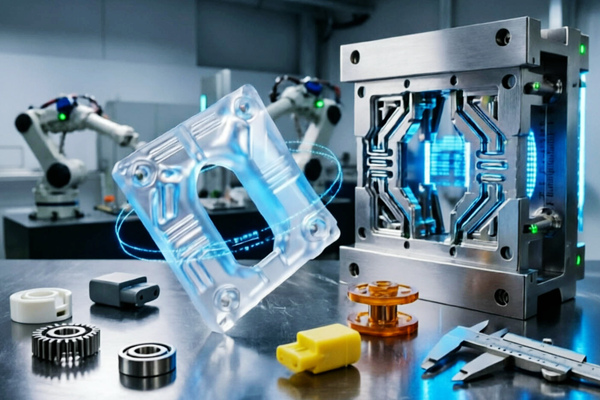
The Indispensable Role of Molded Parts in Volume Manufacturing
The importance of plastic injection molding parts in mass production cannot be overstated. No other polymer process matches injection molding's combination of speed, repeatability, and cost efficiency at high volumes. Once a mold is qualified, a single machine can produce thousands of identical parts per day, and a multi-cavity tool multiplies that output further—sometimes delivering dozens of components in a single cycle. This extraordinary throughput is what makes injection molding the backbone of industries that depend on enormous quantities of consistent parts.
Consider the automotive sector, where a single vehicle may contain thousands of molded components, from dashboards and bumper fascias to connectors and under-hood clips. Producing those parts at the required rate and quality would be impossible without high-cavity molds running around the clock. The same is true in packaging, where billions of caps, closures, and containers are molded annually, and in consumer electronics, where housings and internal brackets must meet tight tolerances at a scale of millions of units. In each case, the molded part is not a niche item but a high-volume commodity whose unit cost falls as production volume rises. The tooling investment, though substantial, is amortized across vast production runs, making injection molding the most economical choice for large-scale manufacturing.
Equally important, high-volume production demands consistency. A molded part that varies from one shot to the next can disrupt automated assembly lines, cause fitment failures, or compromise safety. Injection molding's tightly controlled process parameters—melt temperature, injection pressure, holding time, and cooling—allow manufacturers to hold critical dimensions within very narrow tolerances across millions of cycles. Statistical process control and automated inspection further ensure that every part in a production lot behaves like the one before it. This repeatability is the quiet foundation of modern mass production.
Small-Batch and Custom Production: Flexibility Beyond Mass Manufacturing
Yet the significance of injection molding parts is not limited to enormous volumes. Small-batch and customized production have become increasingly important, and injection molding has adapted to serve them as well. Rapid tooling, aluminum molds, and modular mold inserts have shortened lead times and reduced upfront costs, allowing manufacturers to produce limited runs economically. This capability matters for startups validating a new product, for companies testing market demand before committing to large-scale tooling, and for industries such as medical devices, where specialized instruments may be needed in modest quantities.
Custom production also thrives on injection molding's material versatility. A single mold design can be paired with different resins to produce parts with varied colors, textures, and mechanical properties, enabling manufacturers to customize products for specific customers or applications without rebuilding the tool. Bridge tooling allows a company to begin production while a hardened steel mold is still being fabricated, smoothing the transition from prototype to full-scale output. In this way, injection molding supports the entire product lifecycle—from a handful of validation parts to millions of finished components.
This dual capacity—serving both mass production and small-batch customization—is a major reason injection molding remains so dominant. It gives manufacturers a single, proven process that can scale up or down as market conditions demand.
Design Principles for Molded Components
Design for manufacturability is especially critical in injection molding, because mistakes in geometry are expensive to correct after a mold has been cut. Several rules guide successful part design. Uniform wall thickness is among the most important: abrupt changes in thickness cause uneven cooling, leading to sink marks, warpage, and internal voids. Where thicker sections are unavoidable, ribs or coring can remove material while preserving stiffness.
Draft angles are equally essential. Vertical walls that are perfectly parallel to the direction of mold opening tend to drag against the steel during ejection, causing scuffing or cracking. A slight taper—typically one to three degrees—allows the part to release cleanly. Radiused corners reduce stress concentration and improve material flow, while carefully placed ribs and bosses add structural rigidity without adding unnecessary mass.
Gate location is another decisive factor. The gate is the small opening through which molten plastic enters the cavity. Its position affects weld line formation, air entrapment, and shrinkage patterns. A gate placed poorly can produce weak knit lines where two flow fronts meet, or visible blemishes on a cosmetic surface. Simulation software is often used to predict fill patterns before any steel is machined.
Materials and Their Influence on Part Performance
The choice of polymer shapes nearly every property of the final part. Commodity resins such as polypropylene and polyethylene offer low cost, chemical resistance, and good impact strength, making them suitable for packaging, containers, and household goods. Engineering plastics like ABS, polycarbonate, nylon, and acetal provide higher strength, heat resistance, and dimensional accuracy for automotive, industrial, and electronic applications.
Specialty materials expand the design space further. Glass-filled nylons increase stiffness and reduce thermal expansion. Medical-grade resins must withstand sterilization. Food-contact materials must comply with strict regulatory standards. In each case, the molded part is not merely a shape but a material system whose behavior must be validated through testing.
Tooling, Quality, and Economic Realities
The mold itself is often the largest single investment in an injection molding project. A precision multi-cavity tool made from hardened steel can cost tens of thousands of dollars and take weeks or months to manufacture. This upfront cost explains why injection molding is most economical at high production volumes: the tooling expense is amortized across a large number of parts, driving unit cost down dramatically.
Quality control for molded parts includes dimensional inspection, visual checks for flow lines and short shots, and functional testing. Statistical process control monitors variables such as melt temperature, injection pressure, and cooling time to keep production within tolerance. Modern facilities increasingly use automated vision systems and robotics to maintain consistency at high cycle rates.
Conclusion
Plastic injection molding parts are far more than mass-produced plastic shapes. They represent a disciplined integration of polymer science, mechanical design, and precision manufacturing, and they play an essential role across the entire spectrum of production. In high-volume manufacturing, they deliver unmatched speed, consistency, and cost efficiency; in small-batch and custom production, they offer flexibility, material variety, and rapid iteration. Every rib, gate, draft angle, and material choice carries consequences for performance, cost, and reliability. As industries demand lighter, stronger, and more sustainable components, the field continues to evolve—toward bio-based resins, recycled feedstocks, micro-molding, and digital process optimization. For engineers and manufacturers alike, mastery of injection-molded part design remains a foundational skill, one that quietly enables much of the manufactured world.




