

CNC Complex Machining Parts: Precision, Capability, and the Future of Advanced Manufacturing
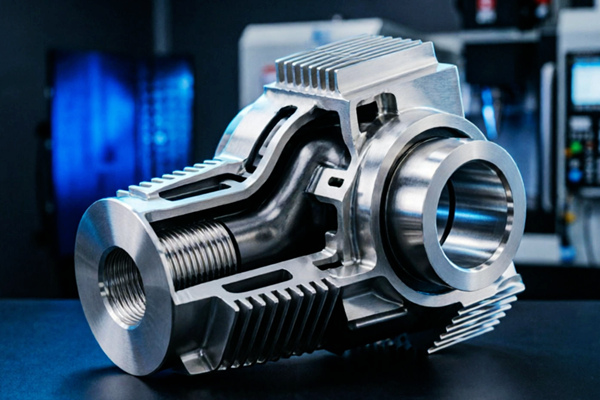
In modern manufacturing, few processes are as foundational—and as quietly transformative—as CNC machining. Among its many applications, CNC complex machining partsrepresent the high end of the discipline: components with intricate geometries, tight tolerances, multiple features, and demanding functional requirements. These parts are rarely simple brackets or basic shafts. They are the mission-critical components found in aerospace engines, medical implants, robotic joints, semiconductor equipment, and high-performance automotive systems. Understanding what makes complex CNC machining different—and why it matters—provides insight into how advanced products are actually built.
What Defines a Complex CNC Machined Part?
Complexity in CNC machining is not a single attribute. It is a combination of factors that push a machine, a programmer, and a process to their limits. A part is generally considered complex when it involves:
Multi-axis geometry:Features that cannot be reached or machined in a single setup, requiring 4-axis or 5-axis simultaneous motion.
Tight tolerances:Dimensions held to ±0.005 mm or finer, often with geometric dimensioning and tolerancing (GD&T) callouts for flatness, concentricity, or position.
Thin walls and delicate features:Structures that tend to vibrate, deflect, or distort during cutting.
Difficult materials:Titanium, Inconel, hardened tool steels, engineering ceramics, and composites that accelerate tool wear and complicate chip control.
Multiple operations:Combining milling, turning, drilling, boring, threading, and even inspection into one continuous process.
When these factors overlap, the margin for error shrinks dramatically. A single incorrect toolpath or clamping decision can scrap an expensive workpiece after hours of machining.
The Role of Multi-Axis Machining
The most visible enabler of complex CNC parts is multi-axis technology. A 3-axis machine moves the tool in X, Y, and Z. A 5-axis machine adds two rotational axes, allowing the tool or the workpiece to tilt and rotate. This capability changes what is possible.
With 5-axis simultaneous machining, a cutting tool can approach a part from virtually any direction. This reduces the number of setups, improves accuracy by minimizing re-fixturing errors, and allows access to features that would otherwise require custom tooling or electrical discharge machining (EDM). For parts with contoured surfaces, angled holes, or undercuts, 5-axis machining is often the only practical solution.
Programming and Simulation: The Invisible Backbone
Complex machining is as much a software challenge as a hardware one. CAM (computer-aided manufacturing) programming for complex parts involves:
Toolpath optimization:Balancing material removal rate with tool life and surface finish.
Collision avoidance:Ensuring the tool holder, spindle, and workpiece never interfere in a multi-axis move.
Feed rate control:Adjusting speeds for varying engagement conditions to avoid chatter and tool breakage.
Simulation and verification:Running virtual machining to catch errors before metal is cut.
Advanced CAM systems now incorporate physics-based simulation and adaptive clearing strategies. These tools allow programmers to predict cutting forces, temperatures, and deflection, turning what was once a trial-and-error process into a more deterministic engineering exercise.
Materials and Tooling Challenges
Complex parts often use materials chosen for performance, not machinability. Titanium alloys, for example, have low thermal conductivity, causing heat to concentrate at the cutting edge. Nickel-based superalloys work-harden rapidly and can destroy tools in minutes if speeds and feeds are wrong. Hardened steels above 45 HRC require cubic boron nitride (CBN) or ceramic tooling.
To manage these challenges, shops rely on:
High-pressure coolant through the spindleto clear chips and control temperature.
Advanced coatingssuch as TiAlN, AlCrN, and diamond-like carbon.
Rigid setupswith minimal overhang and robust workholding.
In-process measurementusing touch probes and laser tool setters.
Quality Control and Metrology
For complex parts, inspection is not a final step—it is integrated into the process. Coordinate measuring machines (CMMs), optical comparators, and white-light scanners verify geometry that traditional gauges cannot easily reach. In high-value industries, parts may be inspected at multiple stages to catch deviations before additional value is added.
Industries That Depend on Complex CNC Parts
Aerospace:Turbine blades, fuel system components, structural fittings.
Medical:Surgical instruments, bone plates, implant prototypes.
Energy:Valve bodies, downhole tools, turbomachinery parts.
Robotics and automation:End effectors, harmonic drive components, custom joints.
Semiconductor:Vacuum chamber parts, gas delivery manifolds, heat sinks.
In each case, failure is not an option. A complex part that is out of tolerance can compromise safety, performance, or reliability.
The Future: Automation, AI, and Digital Threads
The future of complex CNC machining is increasingly digital and automated. Machine learning is being applied to tool wear prediction and adaptive control. Digital twins allow manufacturers to simulate entire production runs. Automated pallet systems and robot tenders keep 5-axis machines cutting around the clock. And the “digital thread”—a continuous data record from design to inspection—ensures traceability and continuous improvement.
Conclusion
CNC complex machining parts are more than machined metal. They are the product of sophisticated programming, advanced tooling, rigid process control, and deep engineering knowledge. As products become more integrated and performance demands rise, the ability to manufacture complex parts efficiently and repeatably will remain a defining capability of advanced manufacturing. For engineers and manufacturers alike, mastering complexity is not just a technical challenge—it is a competitive advantage.




