

Injection Molding in the Robotic Industry Enabling the Next Generation of Automation
Injection molding and robotics have long been intertwined, but the relationship has evolved far beyond the simple use of molded plastic parts in robot housings. Today, injection molding serves as a critical enabling technology for robotic systems themselves—while robotic automation, in turn, is transforming the injection molding process into a highly precise, flexible, and data-driven manufacturing operation. Understanding this two-way relationship is essential for engineers and manufacturers navigating the convergence of plastics processing and intelligent automation.
Molded Components as the Backbone of Robotic Hardware
Modern robots demand components that are lightweight, dimensionally stable, electrically insulating, and cost-effective to produce at volume. Injection molding meets these requirements exceptionally well. Glass-filled nylon and polycarbonate blends are commonly used for structural brackets, joint housings, and end-effector frames, where high strength-to-weight ratios directly influence payload capacity and energy efficiency. Engineering thermoplastics such as PEEK and PPS are specified for components exposed to heat or aggressive chemicals, including motor mounts and gearbox covers in industrial arms.
Beyond structural parts, precision injection molding supports the miniaturization trend in collaborative robots and mobile platforms. Multi-cavity molds with tight tolerances produce connector bodies, sensor housings, and cable management clips at costs that machining or additive manufacturing cannot match at scale. Two-shot molding further integrates soft-touch grips and sealed gaskets directly into rigid housings, reducing assembly steps and improving reliability in human-robot interaction scenarios.
Robotics Transforming the Molding Cell
The reverse direction of this relationship is equally significant. Robots are now standard equipment in injection molding cells, performing part removal, sprue separation, insert loading, and post-mold assembly. Six-axis articulated robots handle complex demolding trajectories that would be difficult or unsafe for human operators, particularly in high-tonnage presses producing large automotive or appliance components. Linear robots, or top-entry models, dominate high-speed take-out applications where cycle time is measured in seconds.
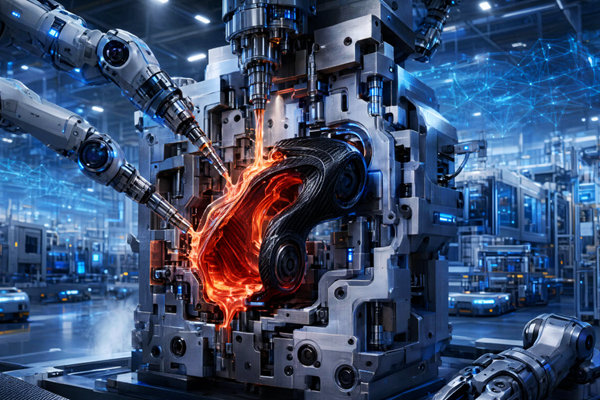
The integration of machine vision has elevated robotic demolding from simple pick-and-place to intelligent handling. Vision-guided robots can locate parts in open molds, inspect for short shots or flash, and sort acceptable parts from rejects without additional stations. This in-line quality control reduces scrap and shortens the feedback loop between molding parameters and downstream defects.
Insert Molding and Overmolding for Robotic Subsystems
A particularly important application area is insert molding, where metal bushings, threaded inserts, or electrical contacts are encapsulated in plastic during the molding cycle. Robots increasingly perform the insert placement itself, achieving positioning accuracy that manual loading cannot sustain over long production runs. This is directly relevant to robotic joint assemblies and actuator components, where metal-to-plastic interfaces must withstand repeated torque loading.
Overmolding of sensors and electronics is another growth area. By encapsulating delicate sensing elements in protective thermoplastic layers, manufacturers produce robust, ingress-protected modules for robot perception systems. Robotic handling ensures consistent insert positioning and prevents contamination during the molding process.
Digital Integration and the Smart Molding Cell
The broader Industry 4.0 trend connects injection molding machines, robots, and quality systems into unified data networks. Mold pressure and temperature sensors feed real-time data to machine learning models that adjust holding pressure or cooling time, while robots report cycle times and handling faults to centralized manufacturing execution systems. This integration supports predictive maintenance of both molds and robotic end-effectors, reducing unplanned downtime.
Sustainability and Material Innovation
Sustainability pressures are reshaping both industries. Recycled and bio-based engineering plastics are entering robotic component production, though their processing windows require careful tuning. Robots also assist in energy optimization—for example, by rapidly removing parts to shorten cooling cycles, or by handling runner systems for regrinding. Molded lightweight components contribute to lower energy consumption in mobile robots and drones, extending battery life.
Conclusion
Injection molding in the robotic industry is not a peripheral supplier relationship but a deeply integrated engineering partnership. Molded parts define the physical capabilities of robots, while robotic automation defines the productivity and precision of modern molding operations. As collaborative robots, soft robotics, and autonomous mobile platforms continue to advance, the demand for sophisticated molded components—and for intelligent robotic handling within molding cells—will only intensify. Professionals in either field benefit from understanding this reciprocal dynamic, which sits at the intersection of materials science, mechanical design, and automated manufacturing.




