

Why 3D Printing Became the Backbone of Robot Customization
Prototyping has always been the bridge between an idea and a manufacturable product. What changed is how fast and how cheaply that bridge can now be crossed. Additive manufacturing compressed prototyping cycles from weeks to hours, and in no field is that shift more visible—or more consequential—than in robotics, where customization is not a feature but the default.
The economics of low-volume, high-complexity work
Robotics customization has a distinctive profile: small batches, high geometric complexity, and requirements tightly bound to a specific task or environment. That profile happens to match the economics of 3D printing almost perfectly. Traditional prototyping—CNC machining, low-volume injection molding, hand-built models—is subtractive, tooling-intensive, or labor-heavy. Every iteration carries real cost, which quietly discourages redesign. Additive manufacturing is different. A digital model is sliced into layers and built up without dedicated tooling. Design changes happen in CAD rather than on the shop floor. A revised part can be printed the same day, and geometrically complex features—internal channels, lattice structures, organic shapes—cost no more to produce than simple ones.
For robot developers, this removes the main friction between a hypothesis and a physical test. When a physical iteration costs hours and modest material expense, teams test more ideas, fail earlier, and converge on better designs.
End effectors: the first battlefield
The core pain point in robot customization often isn't the robot body—it's the end effector. Standard grippers can't handle irregular workpieces, and machined custom tooling takes weeks. Production line changeovers can't wait that long. 3D printing closes the loop from CAD to functional gripper in days. A telling example comes from Anubis 3D, whose vacuum gripper for a food packaging line had to complete its pick task within a 500-gram weight budget. Aluminum was ruled out for exceeding that limit; a polymer part produced via laser powder bed fusion met both the weight and functional requirements. This "weight-sensitive, geometry-free, ultra-low-volume" demand is precisely the zone where 3D printing prototypes are irreplaceable.
Humanoid robots: printing is already mainstream
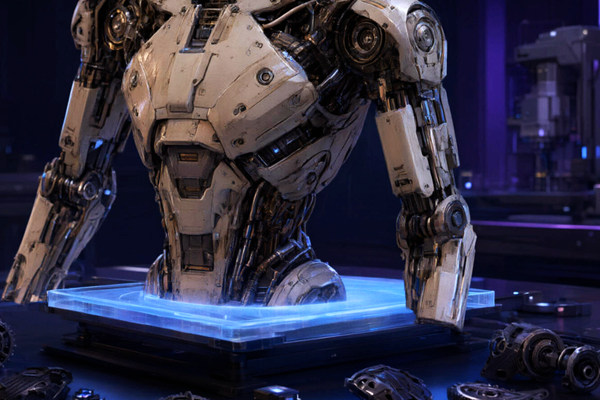
A striking data point comes from recent IEEE research on humanoid robots. Across the open-source platforms surveyed, 3D-printed parts commonly account for 70% to 90% of custom mechanical components by count—covering shells, sensor mounts, cable routing fixtures, hands, and structural frames. In custom humanoid development, 3D printing has moved well past the "occasional use" stage and become the mainstream method for structural design. The same study notes that transmission systems remain a weak point for 3D printing—which neatly defines the sensible boundary: print for rapid validation of structure and integration, keep precision transmission for conventional machining or purchased components.
The gray zone between "prototype" and "functional part" is expanding
A study of competition robots makes the point directly. Pure 3D-printed mobility mechanisms fell short on durability, but hybrid designs combining printed parts with metal components not only let beginners manufacture quickly but also carried 30-kilogram loads while retaining a weight advantage. The lesson for robotics is that the value of a 3D-printed prototype isn't about replacing everything—it's about delivering a usable functional part under specific load and lifetime requirements, using the right material combination and structural strategy. When printed parts are co-designed with metal inserts, standard fasteners, and transmission modules, the line between "prototype" and "finished product" is decided by the application, not the manufacturing method.
Design rules that separate good prototypes from failed ones
Additive manufacturing has its own design language, and robotics stresses every dialect. Anisotropy comes first: FDM parts are weaker along the layer direction, so load paths and print orientation must be planned together. Minimum feature size, wall thickness, and tolerance stack-up differ from machining; threads and precision bores often require post-machining or heat-set inserts. Support removal and surface finish affect both function and appearance. Teams that treat these constraints as design inputs rather than afterthoughts iterate faster, because they avoid reprints caused by predictable failures.
In practice, the strongest programs are hybrid. Printed geometries are combined with machined inserts, laser-cut panels, or off-the-shelf hardware to create test rigs that approximate the final product. Post-processing—vapor smoothing, media blasting, dyeing, electroplating, or annealing—closes the gap between a printed sample and a production-intent part.
A shift in how engineers think
3D printing hasn't merely made prototyping faster; it has changed how designers approach problems. When the cost of iterating on a custom gripper or sensor bracket becomes negligible, robot engineers are far more willing to redesign the end tool for every new workpiece rather than force the workpiece to fit a standard gripper. That "build the tool for the task" mentality may say more about the deeper importance of 3D printing in robot customization than any single technical metric.
The discipline, of course, lies in judgment: choosing the right process for each prototype's purpose, designing for anisotropy and tolerance from the start, and knowing when a hybrid approach or a conventional process is the better tool. Used with that judgment, additive manufacturing turns prototyping from a gate in the development process into a continuous, evidence-driven conversation between design and reality—and in robotics, that conversation is where the best machines come from.




