

The Role of Custom Automotive Prototype Parts in Modern Vehicle Development
The automotive industry has always been a field where innovation cycles determine market survival. Behind every successful vehicle launch lies an invisible but critical phase: prototyping. Before a single production line is tooled, engineers must validate geometry, fit, function, and manufacturability using physical parts. In this context, automotive prototype parts—often referred to in the Chinese manufacturing sector as "shouban" (手板)—have evolved from simple mock-ups into highly engineered, functional components produced through rapid prototyping and custom machining processes.
Why Prototype Parts Matter in Automotive Development
An automotive prototype part serves purposes that go far beyond appearance. It may be a bracket used to verify clearance in an engine bay, a dashboard fascia checked for surface finish and assembly tolerance, or a functional intake manifold tested under thermal load. Each part answers a specific engineering question. The earlier these questions are answered, the lower the risk of costly design changes after hard tooling has been committed.
Traditionally, prototype parts were produced by CNC machining of metal or plastic blocks. While still widely used, this approach has been complemented—and in some cases replaced—by additive manufacturing technologies such as stereolithography (SLA), selective laser sintering (SLS), fused deposition modeling (FDM), and multi-jet fusion (MJF). The choice among these processes depends on the required mechanical properties, surface quality, dimensional accuracy, and quantity.
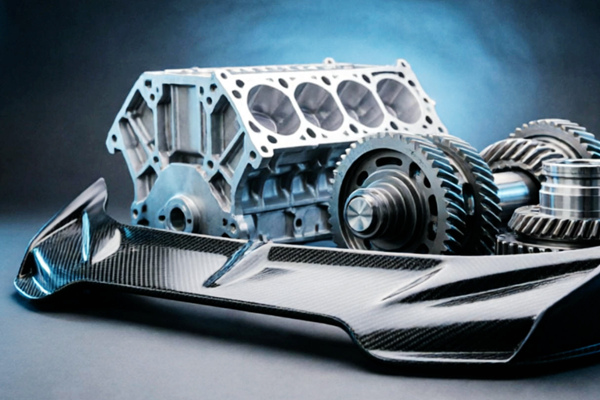
The Rapid Prototyping Workflow for Custom Automotive Parts
A professional prototype customization process typically begins with a 3D CAD model. Engineers review the design for draft angles, wall thickness, and feature accessibility. For CNC-based prototypes, tooling and fixture design follow. For additive processes, support structures and build orientation are planned to minimize distortion and post-processing.
Material selection is a decisive step. Automotive prototypes may require ABS-like photopolymers for visual models, glass-filled nylon for structural brackets, or high-temperature resins for under-hood components. In some cases, metal prototypes are produced via direct metal laser sintering (DMLS) or CNC machining of aluminum and steel alloys. The goal is to approximate the behavior of the final production material without incurring the cost of production tooling.
Post-processing is equally important. SLA parts require support removal, sanding, and sometimes painting to match class-A surface standards. CNC parts may undergo anodizing, bead blasting, or heat treatment. Dimensional inspection using coordinate measuring machines (CMM) or optical scanners ensures that the prototype falls within the tolerances specified by the automotive OEM or Tier 1 supplier.
Applications Across Vehicle Systems
Automotive prototype parts are used across nearly every vehicle subsystem. In interior design, prototype panels, knobs, and trim pieces allow ergonomic evaluation and color matching before injection molds are cut. In powertrain development, prototype intake and exhaust components support flow bench testing and thermal validation. For electric vehicles, battery enclosures, busbar insulators, and thermal management plates are frequently prototyped to validate crashworthiness and electrical insulation.
Exterior applications include grilles, lamp housings, and body cladding. Here, prototypes must often withstand UV exposure and minor impact testing. Functional prototypes for suspension and steering components may be machined from billet aluminum to validate kinematics before casting or forging tools are developed.
Challenges and Best Practices
Custom prototype manufacturing for automotive applications faces several challenges. One is the trade-off between speed and accuracy. While additive manufacturing can deliver a part in days, it may not match the isotropic strength of a machined or molded component. Another challenge is material certification: prototype parts intended for crash or safety testing must often be produced from materials with traceable properties.
Best practices include early involvement of prototype suppliers in the design phase, clear definition of the prototype's purpose (visual, functional, or production-intent), and a structured feedback loop between testing and design revision. Suppliers who offer both additive and subtractive capabilities under one roof can often recommend the most cost-effective process for each part.
The Future of Automotive Prototyping
As vehicle architectures shift toward electric and autonomous platforms, prototype parts will increasingly involve lightweight composites, integrated electronics, and multi-material assemblies. Rapid prototyping will continue to merge with simulation-driven design, allowing engineers to iterate virtually before committing to physical parts. At the same time, the demand for custom, low-volume prototype manufacturing will remain strong, particularly for validation fleets, motorsport, and aftermarket performance applications.
In conclusion, automotive prototype parts are not merely temporary stand-ins. They are engineering instruments that de-risk development, shorten timelines, and enable innovation. In the hands of skilled rapid prototyping and custom machining partners, a simple shouban can become the difference between a design that works on screen and a vehicle that performs on the road.




