

Custom Acrylic Machining-Precision, Process, and Cross-Industry Application
Custom acrylic machining has become a cornerstone of modern product development, bridging the gap between rapid prototyping and production-grade manufacturing. Acrylic—poly(methyl methacrylate), or PMMA—is a transparent thermoplastic prized for its optical clarity, mechanical strength, and excellent machinability. When fabricated to custom specifications through CNC milling, turning, drilling, and laser cutting, acrylic components serve industries ranging from medical devices and automotive lighting to retail displays and architectural glazing. What makes this fabrication discipline distinctive is not merely its technical capabilities but its remarkable adaptability across sectors with wildly divergent performance requirements. Understanding both the technical nuances of custom acrylic machining and the way different industries exploit the same core capabilities is essential for engineers and designers seeking to balance aesthetics, tolerances, and cost.
Why Acrylic Is Suited to Custom Machining
Acrylic offers roughly 92% light transmission, comparable to glass but at less than half the weight. It resists shattering, making it safer for consumer-facing parts and protective enclosures. From a machining standpoint, acrylic behaves predictably: it chips cleanly, holds tight tolerances, and accepts polished finishes that restore transparency after cutting. Its relatively low melting point, however, demands careful thermal management. Unlike metals, acrylic is sensitive to heat buildup during cutting; excessive friction can cause gumming, stress cracking, or a hazy "melted" edge. Successful custom acrylic machining therefore depends on optimized tool geometry, feed rates, and coolant or air-blast strategies. Cast acrylic machines more cleanly and resists crazing better than extruded acrylic, though extruded sheet is more economical for simple, thin parts—a material selection decision that shapes both quality and cost from the outset.
Core Machining Processes
CNC milling is the workhorse for custom acrylic parts with complex 2.5D or 3D geometry—recessed pockets, mounting bosses, and contoured edges. Single-flute or double-flute end mills designed for plastics reduce heat and evacuation problems. CNC turning produces cylindrical components such as light guides, bushings, and fluidic fittings with concentricity and surface finish that hand fabrication cannot match. Laser cutting excels at fast, burr-free profiling of flat acrylic sheet, enabling intricate signage, display fixtures, and gasket-like parts. CO₂ lasers are standard; edge quality depends on power, speed, and assist gas, and thicker sections may require flame polishing to restore clarity. Drilling demands sharp, polished bits with a moderate helix angle and backing support to prevent exit burrs and crazing. Threading and tapping acrylic are feasible but benefit from cut taps rather than form taps to minimize stress.
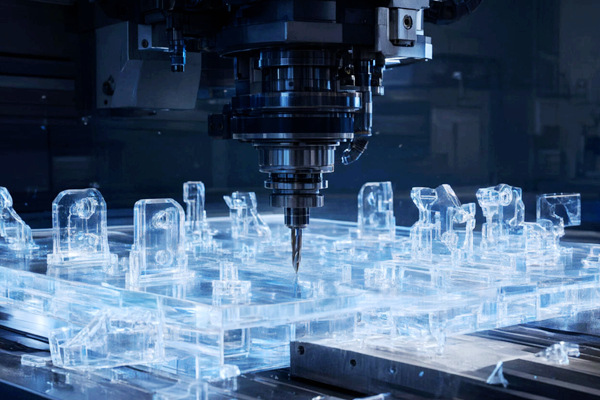
Typical CNC tolerances for custom acrylic machining range from ±0.005 in (±0.13 mm) on critical features, with tighter tolerances achievable on smaller parts. Designers should avoid over-specifying flatness across large panels, as acrylic expands and contracts with temperature and humidity—its coefficient of thermal expansion is roughly seven times that of steel. Annealing machined parts relieves internal stresses introduced during extrusion or cutting, reducing the risk of environmental stress cracking, particularly when parts contact solvents or adhesives. Finishing options define the final product's character: as-machined surfaces appear frosted, vapor polishing with methylene chloride produces a glass-like clarity, flame polishing offers a faster but less uniform result, and sandblasting creates diffused, matte surfaces ideal for backlit signage. Edge polishing, chamfering, and laser engraving add functional and decorative value, while solvent bonding with dichloromethane or acrylic-compatible adhesives creates strong, transparent joints when parts are properly annealed and fit-up is precise. Design for manufacturability begins with minimizing setups, standardizing hole sizes, and avoiding deep, narrow pockets to reduce cycle time—and prototyping via CNC is often more cost-effective than injection molding for low-to-mid volumes, supporting design iterations without tooling investment.
A Cross-Industry Enabler
What elevates custom acrylic machining beyond a single-sector service is how the same core capabilities translate across industries with very different priorities. In medical and laboratory settings, visibility and hygiene are inseparable. Custom machined acrylic components serve as observation windows, fluid path manifolds, and reagent container elements where clinicians must visually confirm sample status or fluid flow without opening a closed system. Japanese precision machining services report achieving tolerances of ±0.02 mm for medical-grade acrylic parts, a level of accuracy necessary for diagnostic analyzers and infusion devices where dimensional error can compromise device function. The material's resistance to alcohol and UV sterilization without yellowing or cracking supports use in clinical environments where repeated disinfection is routine, and transparent flow channels allow direct observation of fluid dynamics that would be invisible in metal equivalents.
The automotive industry relies on custom acrylic machining for a purpose distinct from end-use production: visual validation. Transparent acrylic models allow engineers to inspect internal assemblies, fluid pathways, and packaging clearances before committing to tooling. Japanese prototyping specialists note growing demand for clear-machined acrylic visualization models produced on five-axis machining centers, achieving surface finishes free of the cloudiness that typically results from cutting acrylic. Beyond visualization, functional prototype components such as display panels and aerodynamic fairings are machined for design evaluation and fit-checking, with turnaround measured in days rather than the weeks required for molded alternatives.
Semiconductor manufacturing equipment demands materials that are simultaneously transparent, chemically stable, and machinable to precise geometries. Acrylic serves as protective covers, internal inspection windows, and structural components where process visibility is required. One documented application involves acrylic probe holders for substrate testing equipment, where fine holes are machined to accept press-fit probe pins—a task requiring both precision drilling and electrical insulation properties. The ability to combine machining with post-machining bending expands acrylic's utility in space-constrained equipment enclosures, though this requires careful thermal control to avoid loss of transparency or dimensional distortion.
At the opposite end of the volume-and-scale spectrum, retail and architectural applications demonstrate acrylic's aesthetic range. Encapsulated acrylic channel letters—CNC-machined two-piece systems with a face and backer—exemplify how machining enables signage that is both structurally robust and optically striking, with sharp corners and minimal design limitations. Large-format fabricators serve retail display and signage markets with integrated machining, laser cutting, and forming capabilities, producing everything from point-of-sale fixtures to backlit brand elements. In architectural and aquatic applications, custom acrylic components extend to pressure vessels for human occupancy, aquarium viewing panels, and complex thermoformed geometries, where machining and forming are combined under one roof to maintain tolerance control across large assemblies.
The Common Thread and Practical Implications
Across these industries, the unifying driver is a specific material property combination that few alternatives match: optical transparency paired with genuine machinability. Metals can be machined precisely but are opaque. Glass offers clarity but is brittle and difficult to machine into complex geometries without costly processes. Acrylic occupies a practical middle ground—transparent enough for visual verification, tough enough for structural roles, and machinable to tolerances that satisfy medical and semiconductor requirements as well as signage aesthetics. The differences lie in the specifications each industry imposes: medical machining prioritizes sub-0.05 mm accuracy and sterilization compatibility; automotive prototyping emphasizes surface clarity and speed; signage tolerates broader dimensional variation but demands edge finish and light diffusion quality. Fabricators that understand these divergent priorities can adapt process parameters—tooling, feeds, annealing, polishing—accordingly.
This cross-industry adaptability explains why custom acrylic machining persists as a distinct fabrication discipline rather than being absorbed into general plastics machining. The material rewards specialized knowledge: heat management during cutting, stress relief before or after machining, and finish techniques that restore optical clarity all require experience that general-purpose machine shops often lack. In summary, custom acrylic machining combines optical excellence with engineering versatility and cross-sector relevance. Success hinges on controlling heat, selecting appropriate tooling and material grade, specifying realistic tolerances, planning post-processing, and recognizing that the same workshop capabilities can serve a diagnostic analyzer, an automotive validation model, a semiconductor fixture, and a retail display—provided the fabricator understands the specific demands of each application. When these factors are managed, machined acrylic delivers durable, high-clarity components that meet demanding functional and aesthetic requirements across diverse industries.




