

The Flexible Application of Complex CNC Milling Parts in Rapid Prototyping
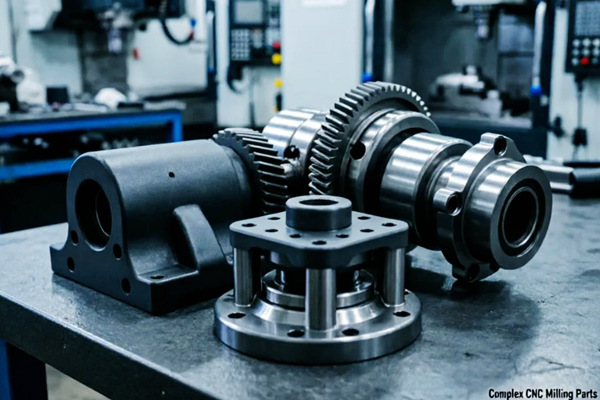
In the contemporary landscape of product development, the race to market is often won or lost in the prototyping phase. The ability to translate a digital blueprint into a physical, functional object quickly is no longer a luxury; it is a prerequisite for survival. Among the various manufacturing technologies available for this critical stage, Computer Numerical Control (CNC) milling stands out as a bastion of versatility and precision. Specifically, the machining ofcomplex CNC milling partshas revolutionized rapid prototyping, offering an unparalleled blend of material authenticity, geometric accuracy, and structural integrity. Whether working with engineering-grade plastics or high-strength metals, complex CNC milling provides a flexible, reliable bridge between conceptual design and mass production, ensuring that functional validation is not just a box-ticking exercise but a robust scientific process.
The Geometric Freedom of Multi-Axis Milling
The primary reason CNC milling remains indispensable in prototyping is its capacity to handle geometric complexity. While 3-axis milling is sufficient for basic features, the advent of 4-axis and 5-axis machining centers has unlocked a new dimension of possibility. Complex parts featuring intricate curves, deep cavities, sharp internal corners, and complex undercuts—once the exclusive domain of casting or multi-part assemblies—can now be machined as a single, cohesive unit.
This capability is transformative for rapid prototyping. In the automotive sector, for instance, the prototype of a turbocharger housing or a cylinder head requires internal cooling channels and complex port geometries that affect fluid dynamics. A 5-axis CNC mill can approach the workpiece from virtually any angle, allowing the cutting tool to maintain optimal positioning relative to the surface. This eliminates the need for multiple set-ups, drastically reducing the time it would take to manufacture the part—often a matter of hours or days rather than weeks. More importantly, machining a complex geometry from a solid block of material ensures that the prototype behaves exactly as the production part would, without the structural weaknesses associated with glued assemblies or 3D-printed layers that can delaminate under stress.
Material Versatility: Bridging Plastics and Metals
While additive manufacturing (3D printing) has gained significant traction in prototyping, its material palette remains relatively limited and often lacks the exact mechanical properties of production-grade polymers or metals. This is where CNC milling shines. The process is inherently material-agnostic; if a material can be held in a vice, it can be milled.
For plastic prototyping, CNC milling allows engineers to work with materials that mimic the exact behavior of final production resins. Whether it is Acrylonitrile Butadiene Styrene (ABS), Polycarbonate (PC), Polyether Ether Ketone (PEEK), or Acrylic (PMMA), a complex CNC mill can produce clear, heat-resistant, or high-impact parts that replicate the final injection-molded component. This is particularly crucial for parts requiring optical clarity or specific biocompatibility, such as medical device housings. While stereolithography (SLA) can produce clear parts, the surface finish and internal material structure differ significantly from molded plastic. CNC milling produces a homogenous part with consistent density, ensuring that stress-strain testing conducted on the prototype accurately reflects the performance of the production version.
For metal prototyping, the contrast is even starker. Complex CNC milling is the gold standard for producing functional metal prototypes in Aluminum 6061, 7075, Stainless Steel 304, Titanium, or Inconel. These materials are notoriously difficult to print with standard powder-bed fusion due to thermal stress and porosity issues. However, a complex CNC mill can machine intricate fins, ribs, and bosses from a forged or rolled billet. This "wrought" structure retains the grain flow of the material, resulting in a prototype that possesses superior fatigue resistance and structural rigidity. In the aerospace industry, a complex structural bracket or a hydraulic manifold prototype must withstand extreme pressures and temperatures; only a machined metal part can provide the certainty required for high-risk validation.
The Functional Validation Advantage
The ultimate goal of rapid prototyping is functional validation. It is not enough for a prototype to look like the final product; it must act like it. Complex CNC milling excels in this domain by producing parts that are ready for "fit, form, and function" testing immediately.
Fit and Assembly: For complex assemblies with tight tolerances (often within±0.005 inches or tighter), CNC milling ensures that mating surfaces, threads, and dowel pin holes are perfectly aligned. This allows design engineers to test the ergonomics, clearance, and assembly sequences of the product. If a complex gearbox casing is milled to spec, engineers can install bearings and shafts to test rotational performance and thermal expansion—tasks that are nearly impossible with rubber-like or layered prototypes.
Thermal and Mechanical Stress: Complex CNC parts excel under static and dynamic load testing. In the robotics industry, custom end-effectors and joints are subjected to repetitive motion and high torque. A CNC-machined aluminum or steel prototype allows strain gauges to be attached to the material surface to measure stress distribution. Because the material is isotropic (having the same properties in all directions), as opposed to the anisotropic nature of printed parts, the data collected is accurate and actionable.
Fluid and Airflow Dynamics: For applications involving gas or liquid flow, such as manifolds, pump housings, or aerodynamic surfaces, the surface finish achievable with CNC milling is critical. The process leaves a polished surface that reduces friction and turbulence. Complex internal channels, when precision-milled, can be polished to a mirror finish, ensuring that flow rates in the prototype match theoretical calculations. This is invaluable for the fluid power industry, where a slight deviation in channel geometry can cause catastrophic cavitation or pressure drops.
Flexibility in Iteration and Lead Time
The rapid prototyping industry thrives on iteration. Design flaws are typically discovered only when a physical part is tested. Here, complex CNC milling offers a distinct advantage: the flexibility to adjust CAD models quickly and re-machine the part. Because the process relies on subtractive manufacturing via digital toolpaths, modifying a surface radius or adding a strengthening rib is simply a matter of updating the CAM (Computer-Aided Manufacturing) software.
Contrast this with the production of tools for injection molding, which can take months and cost tens of thousands of dollars. With CNC milling, complex parts can be produced in as little as 24 to 48 hours. This agility allows engineering teams to run multiple design-of-experiment (DOE) cycles within a single week. If a complex plastic part fails in drop testing, it can be reinforced and re-machined on the same machine without waiting for a new mold insert.
Furthermore, the process is scalable. The same program used to mill a single prototype can be used to produce a bridge run of 50 to 100 parts for pilot production while the permanent tooling is being finalized. This is particularly beneficial for industries like medical devices, where regulatory approvals often require extensive testing on devices that must be identical to the final marketed version. The ability to use the same material, the same toolpath, and the same machine to produce both the validation prototype and the clinical trial units ensures consistency and mitigates risk.
Complementing Additive Manufacturing
While this article focuses on subtractive CNC processes, it is worth noting that in the realm of complex parts, CNC milling often operates as a finishing tool for other processes. For components that are near-net shape (cast or printed), complex CNC milling provides the critical "subtractive finishing" to achieve the tight tolerances and surface finishes that additive processes cannot provide. In this hybrid workflow, the mill acts as the final arbiter of precision, removing support structures and machining critical interfaces, thereby maintaining its pivotal role in the functional validation of complex parts.
Conclusion
In conclusion, complex CNC milling remains the most reliable, flexible, and accurate manufacturing process for functional rapid prototyping. Its ability to navigate intricate geometries, its compatibility with a vast spectrum of plastics and metals, and the exceptional mechanical integrity of the parts produced make it an indispensable tool for engineers across all sectors. From the high-stakes environment of aerospace to the life-critical nature of medical devices, and from the high-performance demands of automotive to the miniaturization trends in electronics, CNC machining provides the tangible proof needed to validate ambitious designs. As materials science and toolpath algorithms continue to evolve, the role of complex CNC milling will only grow, ensuring that the bridge between an idea and a physical reality is not just fast, but impeccably accurate and functionally robust.




