

A Guide to CNC Machining Complex Parts
In the world of handboard manufacturing and rapid prototyping, few technologies have reshaped what’s possible quite like CNC machining. While 3D printing often grabs the headlines, CNC machining complex parts remains the gold standard for functional accuracy, material integrity, and surface finish. This blog explores how manufacturers push the boundaries of subtractive manufacturing to create intricate components that once seemed impossible.
Why CNC Machining Still Leads for Complex Geometries
When engineers hear “complex parts,” they often think of deep internal cavities, thin walls, compound angles, and micron-level tolerances. Additive manufacturing can produce such shapes, but not always with the structural properties of wrought metals or engineering plastics. CNC machining bridges this gap. By starting from a solid block of material—aluminum, stainless steel, PEEK, or ABS—the process ensures uniform grain structure and predictable mechanical behavior.
For handboard makers, this means a prototype that behaves exactly like the final production part. A CNC-machined turbine impeller or multi-axis bracket can withstand heat, vibration, and load testing without the anisotropy issues sometimes seen in printed parts. That reliability is why industries from aerospace to medical devices still specify CNC machining for their most demanding prototypes.
Core Challenges When Machining Complex Parts
Not every shop can successfully machine a complex geometry. Three main hurdles separate amateurs from professionals:
· Tool access and interference– Deep pockets or undercuts require specialized long-reach tools or 5-axis strategies to avoid collisions.
· Workholding rigidity– Thin webs and fragile features demand custom fixtures or vacuum chucks to prevent chatter or part deflection.
· Thermal management– High material removal rates generate heat that can distort thin walls. Proper coolant application and adaptive toolpaths are non-negotiable.
Overcoming these requires both advanced machinery and experienced programming. A standard 3-axis mill with basic CAM software will struggle with features like inclined holes or contoured surfaces. That’s where multi-axis machining becomes essential.
The Role of 5-Axis Machining in Unlocking Complexity
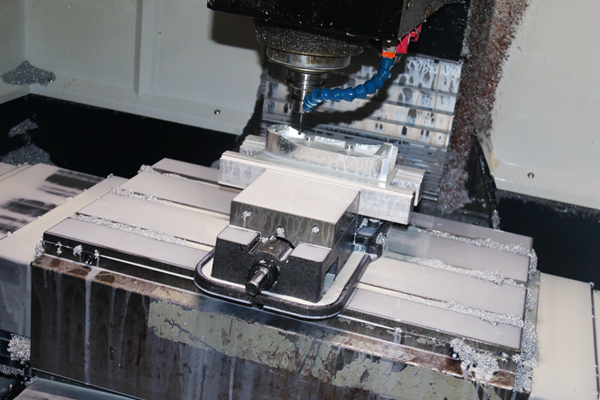
To consistently produceCNC machining complex parts, 5-axis technology has become a game-changer. Unlike 3-axis machines, which approach the part from fixed directions, 5-axis systems rotate the cutting tool and/or workpiece simultaneously. This allows:
· Single-setup machining of undercuts and angled features, eliminating multiple re-clamping errors.
· Shorter, more rigid tools because the machine can tilt the tool away from walls, reducing chatter.
· Superior surface finish on freeform surfaces like blisks or ergonomic handles.
For a handboard shop, investing in 5-axis capability means saying “yes” to parts that competitors might decline—such as a complex medical implant trial or a lightweight drone motor housing with internal cooling channels.
Material Selection: Matching Process to Purpose
The complexity of a part isn't just about shape—it's also about material behavior. Some alloys, like 6061 aluminum, are forgiving and ideal for initial complex prototypes. Others, like Inconel or hardened tool steel, demand slower feeds, specialized coatings, and rigid setups.
Plastics present their own challenges: machining PEEK or Ultem requires sharp tools and efficient chip evacuation to prevent melting. Acrylic needs careful feed rates to avoid cracking. A knowledgeable CNC partner will advise on material choices that balance machinability with final application requirements.
Design for Machinability (DFM) Tips for Engineers
You can save time and cost by designing with CNC limitations in mind. Here are three practical tips when creating a model intended for machining:
· Avoid sharp internal corners – Use a radius at least 1.5x the cutter diameter. A 0.5mm radius is impossible with a standard end mill.
· Consider tool access – Ensure every feature can be reached by a straight, rotating tool. Deep, narrow slots may require EDM instead.
· Specify realistic tolerances – Don’t call out ±0.01mm on a cosmetic surface. Reserve tight tolerances for critical mating features.
Following these guidelines won’t stifle innovation—it will help your handboard partner deliver a part that actually works the first time.
Real-World Applications: Who Needs CNC-Machined Complex Parts?
Demand spans multiple sectors. Aerospace engineers need complex structural brackets with lightening pockets. Automotive R&D teams test intake manifolds with serpentine internal passages. Medical device firms require spinal implant prototypes with bone-like porosity textures. Even consumer electronics uses CNC for intricate heat sinks and hinge mechanisms.
In each case, the unifying factor isCNC machining complex partsthat are both functional and faithful to production intent.
Conclusion: Partnering for Precision Success
Producing complex CNC-machined handboards isn't just about owning a five-axis mill. It requires experienced machinists who understand toolpath optimization, workholding ingenuity, and material behavior. Whether you’re validating a radical new design or creating a master pattern for silicone molding, choosing a partner with deep CNC expertise makes all the difference.
Ready to turn your complex CAD model into a precision handboard? Start by sharing your 3D file and tolerance block—the right machinist will see complexity not as a barrier, but as an opportunity.




