

The Unmatched Value of CNC Machined Enclosures
In the world of prototyping and low-volume production, the enclosure is far more than just a protective shell—it is the face of your product. When precision, durability, and aesthetics are non-negotiable, the manufacturing process matters as much as the design itself. This is where CNC machined enclosures take center stage. As a professional in the realm of prototype manufacturing, I have seen countless projects succeed or fail based on the quality of their casing. Today, let’s dive into why CNC machining remains the gold standard for creating high-end enclosures.
The Quest for Dimensional Accuracy
One of the primary reasons engineers and designers gravitate toward CNC machined enclosures is the unparalleled dimensional accuracy. Unlike casting or 3D printing, which can suffer from warping or shrinkage, CNC machining operates directly from a solid block of material. The process removes material with micron-level precision.
For functional prototypes, this accuracy is critical. If your enclosure houses a complex PCB with specific port alignments or requires a tight seal against dust and moisture, even a 0.1mm deviation can cause assembly failures. CNC machining ensures that every screw hole, edge, and mating surface adheres strictly to your CAD model. This “first-time-right” capability drastically reduces the iteration cycle, saving weeks of development time.
Material Versatility: Beyond Plastic
When we talk about hand feel and durability, material selection is paramount. One significant advantage of CNC machined enclosures is the vast range of materials available. While injection molding locks you into the constraints of thermoplastic flow, CNC allows you to machine enclosures from engineering-grade materials that are otherwise difficult to mold.
For high-end consumer electronics or industrial handheld devices, aluminum 6061 or 6063 is a popular choice. It offers excellent thermal conductivity (helping to dissipate heat from internal components), electromagnetic interference (EMI) shielding, and a premium weight that conveys quality. For applications requiring non-conductivity or radio-frequency transparency, we can machine POM, ABS, or even PEEK. This flexibility allows startups and R&D departments to test the actual mechanical properties of the material before committing to mass production tooling.
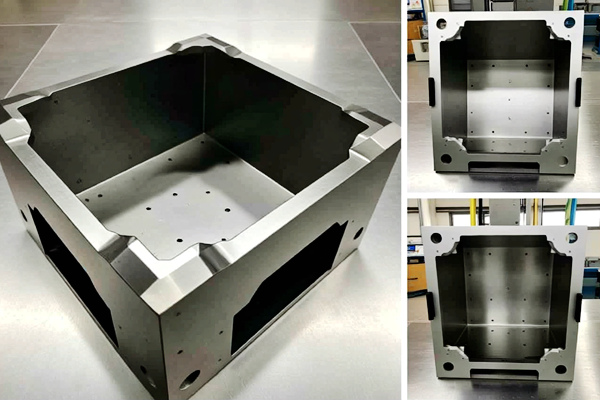
The Aesthetics of a Premium Finish
In the consumer market, the visual and tactile appeal of a device often dictates its perceived value. CNC machined enclosures excel in surface finish. Because the part is held rigidly in place during cutting, we can achieve surface finishes as smooth as Ra 0.8 micrometers directly off the machine.
Furthermore, the post-processing options are extensive. For metal enclosures, we can apply bead blasting to create a matte, non-slip texture, followed by anodizing. Anodizing not only adds vibrant color options but also hardens the surface, making it scratch-resistant. For plastic enclosures, vapor smoothing or painting can eliminate any visible tool marks. This level of aesthetic control is often necessary for investor demonstrations, trade show displays, or market testing where the look and feel must mirror the final production model.
Structural Integrity for Functional Testing
A prototype is only useful if it can withstand real-world conditions. In my experience, one of the overlooked benefits of CNC machining is the structural integrity of the final part.
When you machine an enclosure from a solid block of aluminum or polycarbonate, the resulting part is monolithic—it has no layer lines (like 3D printing) or weld lines (like injection molding). This makes the enclosure incredibly robust. For products that need to pass drop tests, vibration analysis, or thermal cycling, a CNC machined enclosure provides data that is far more reliable than what you would get from additive manufacturing. It allows engineers to conduct destructive testing with confidence, knowing that any failure is a design flaw, not a manufacturing artifact.
Speed to Market and Low-Volume Viability
Perhaps the most practical advantage for businesses today is speed. In the era of agile development, waiting 6 to 8 weeks for an injection molding tool to be made is often a non-starter. CNC machining offers a rapid turnaround. Without the need for hard tooling, we can produce a batch of 5 to 200 CNC machined enclosures in as little as 3 to 5 business days.
This makes it the ideal bridge tooling solution. It allows companies to launch pilot runs, fulfill pre-orders, or conduct field testing with parts that are essentially production-grade. Once the design is validated, the CNC program can serve as a reference for the future injection mold design, ensuring a seamless transition from prototype to mass production.
Conclusion
Choosing the right manufacturing partner for your enclosure is a strategic decision. CNC machined enclosures offer a unique combination of precision, material strength, aesthetic quality, and speed that other prototyping methods simply cannot match. Whether you are a hardware startup preparing for a launch or an engineer validating a rugged industrial design, CNC machining provides the reliability needed to bring your vision to life.
When you invest in a CNC machined enclosure, you are not just buying a box; you are investing in the quality assurance of your entire product. If you are ready to move your project to the next level, consider CNC machining the cornerstone of your development process.




