

Urethane Vacuum Casting: A Practical Guide for Product Developers
Urethane vacuum casting is one of those manufacturing processes that rarely makes headlines but quietly underpins a huge share of product development work. It sits between hand-made prototypes and injection-molded production parts, and for many teams it is the first point at which a design becomes something you can actually hold, test, and show to a customer. This article looks at the process from the perspective of the people who use it—designers, engineers, and project managers—and explains what it can do, where it fits, and how to get the best results from it.
What the Process Actually Involves
The workflow starts with a master pattern, usually produced by SLA or PolyJet 3D printing, though CNC-machined masters are common when tight tolerances or specific surface finishes are required. The master is finished, suspended in a casting frame, and encapsulated in a two-part silicone rubber. After the silicone cures, the frame is opened along a planned parting line and the master is removed, leaving a flexible negative cavity.
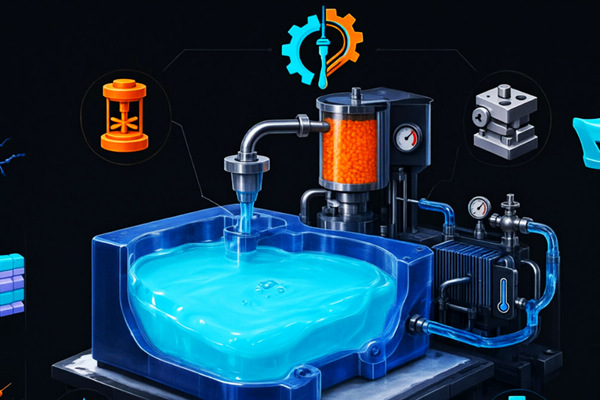
Casting itself takes place under vacuum. The silicone mold is placed in a vacuum chamber, the air is evacuated, and a two-component polyurethane resin is mixed and poured. Because the cavity and the resin are both degassed, air entrapment is minimized, which is essential for reproducing fine detail, thin walls, and optically clear parts. The filled mold is then cured, opened, and the casting is demolded, trimmed, and finished.
Why Designers Choose It
The most obvious attraction is speed. A finished master can become a cast part in a few days, which means design iterations happen in days rather than weeks. That speed changes how teams work: instead of debating a design in CAD, they can print a master, cast a handful of parts, and put them in the hands of testers, focus groups, or mechanical engineers.
The second attraction is material breadth. Polyurethane systems are available as rigid plastics, flexible elastomers, transparent resins, and flame-retardant grades, and many are formulated to mimic engineering thermoplastics such as ABS, polypropylene, or polycarbonate. This lets a team evaluate not just form and fit but function—living hinges, snap fits, seals, and grip surfaces can all be tested in a material that behaves like the intended production resin.
The third is cost efficiency at low volume. A silicone mold costs a fraction of a steel tool, and a single mold typically produces twenty to fifty parts before wear becomes significant. For prototype quantities, pilot builds, and bridge production, that economics is hard to beat.
Where the Process Has Limits
Vacuum casting is not a production process, and pretending otherwise leads to disappointment. Cycle times are measured in hours rather than seconds, labor content is high, and the silicone mold degrades with every cast. Dimensional repeatability is good but not equal to a hardened steel tool, and aggressive or high-temperature resins can attack the silicone. Part size is constrained by the vacuum chamber and by the mold's ability to hold its shape, although large-format systems continue to extend these boundaries.
Designers also need to think about the process during CAD. Generous draft angles, well-placed gates, and allowance for casting shrinkage all matter, and features that would be trivial in injection molding—deep ribs, sharp internal corners, undercuts—may require split molds or inserts.
Getting the Most from a Casting Project
The quality of a cast part is largely determined before the resin is poured. A well-finished master is essential: any tooling marks, layer lines, or support scars will be reproduced faithfully in every casting. Planning the parting line carefully reduces flash and post-processing. Choosing the right polyurethane grade matters as much as choosing the right mold, and it is worth requesting sample coupons to confirm hardness, color, and mechanical behavior before committing to a full batch.
Finally, it helps to treat vacuum casting as one step in a chain rather than a standalone solution. Masters can be revised quickly, molds can be remade, and castings can feed into assembly trials, regulatory testing, or customer evaluations. Used this way, urethane vacuum casting becomes less a manufacturing method and more a tool for reducing risk—allowing teams to learn fast, fail cheaply, and reach production with greater confidence.




