

Rapid Prototype CNC Parts Accelerating Product Development with Precision and Speed
In the competitive landscape of modern manufacturing, the ability to move from concept to tangible product quickly can determine a company's success. Rapid prototyping has become an indispensable phase in product development, and among the various techniques available, CNC (Computer Numerical Control) machining stands out as a cornerstone technology for producing functional, high-fidelity prototype parts. Rapid prototype CNC parts bridge the gap between design intent and real-world validation, offering unmatched precision, material versatility, and surface quality.
What Are Rapid Prototype CNC Parts?
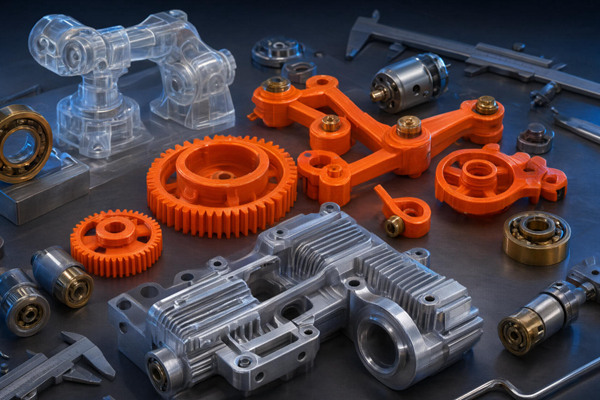
Rapid prototype CNC parts are components manufactured through subtractive machining processes—such as milling, turning, drilling, and routing—driven by digital design files. Unlike additive manufacturing (3D printing), which builds parts layer by layer, CNC machining starts with a solid block of material and removes excess stock to achieve the desired geometry. This subtractive approach is particularly valuable when prototypes must replicate the mechanical properties, tolerances, and finishes of final production parts.
The "rapid" aspect refers to the streamlined workflow: CAD models are translated into toolpaths, and machining centers operate at high speeds with minimal setup time. Modern CNC shops often leverage high-speed machining, multi-axis capabilities, and automated fixturing to compress lead times from days to hours for simple geometries.
Why Choose CNC for Prototyping?
Several characteristics make CNC machining a preferred choice for rapid prototyping:
Material Diversity: CNC processes work with virtually any machinable material, including engineering plastics (ABS, POM, PC, PEEK), light metals (aluminum alloys), and harder metals (stainless steel, titanium, brass). This allows designers to test prototypes under realistic conditions—thermal, chemical, and mechanical—rather than relying on surrogate materials.
Tight Tolerances and Repeatability: CNC machining routinely achieves tolerances of ±0.005 inches or tighter, with excellent repeatability. For prototypes involving mating components, sealing surfaces, or precision mechanisms, this accuracy is critical.
Superior Surface Finish: Machined parts can be produced with smooth as-machined surfaces or further refined through bead blasting, anodizing, polishing, or coating. This helps evaluate both aesthetics and function early in development.
Scalability to Production: A prototype machined from the intended production material using the same or similar processes provides a direct pathway to low-volume production. Design for manufacturability (DFM) issues surface early, reducing costly surprises at scale.
Applications Across Industries
Rapid prototype CNC parts serve a wide range of sectors. In aerospace, machined aluminum and titanium brackets, housings, and fixtures undergo fit checks and load testing before committing to tooling. Medical device developers use CNC to produce biocompatible instrument components and implant prototypes for verification. Consumer electronics benefit from machined enclosures and heat sinks that validate thermal performance and ergonomics. Automotive and motorsport teams rely on CNC prototypes for intake manifolds, suspension components, and custom fittings. Even robotics and industrial automation leverage machined end-effectors, mounting plates, and precision gears during proof-of-concept stages.
Best Practices for Rapid CNC Prototyping
To maximize the value of CNC prototyping, engineers should follow several guidelines. First, design with machining in mind: avoid unnecessary undercuts, deep narrow pockets, and sharp internal corners that require specialized tooling. Second, provide complete 3D models and specify critical dimensions, tolerances, and surface finish requirements clearly. Third, consider material selection early—not just for mechanical properties but also for machinability and availability. Fourth, communicate the prototype's purpose: a fit-check part may tolerate looser tolerances than a functional stress-test specimen. Finally, work with a machining partner experienced in rapid turnaround and prototype-scale quantities, as their process knowledge can prevent delays.
Challenges and Mitigations
CNC prototyping is not without limitations. Setup costs per unique part can be higher than 3D printing for extremely complex geometries, and material waste is inherent to subtractive processes. Thin walls and delicate features may require special fixturing or support. However, these challenges are often outweighed by the need for functional testing and production-representative properties. Hybrid approaches—combining CNC with additive manufacturing or casting—can further optimize cost and speed.
Conclusion
Rapid prototype CNC parts represent a powerful enabler of innovation. By delivering functional, precise, and material-accurate components quickly, CNC machining allows design teams to validate ideas, iterate rapidly, and de-risk production transitions. As digital manufacturing continues to evolve—with advances in automation, simulation, and multi-axis machining—the speed and accessibility of CNC prototyping will only improve. For organizations seeking a competitive edge through faster, more reliable product development, investing in rapid CNC prototyping capabilities is not merely an option; it is a strategic necessity.




