

The Versatility and Practicality of Stainless Steel CNC Machining Services
In the modern manufacturing landscape, few technologies have redefined precision and adaptability quite like CNC (Computer Numerical Control) machining. When paired with stainless steel—a family of alloys renowned for strength, corrosion resistance, and longevity—the result is a service that stands as a cornerstone of industrial production. From medical implants to marine hardware, stainless steel CNC machining services offer an unmatched combination of material science and digital precision, delivering components that are as flexible in application as they are durable in performance.
The Strategic Edge of Material Selection
The heart of any successful CNC project lies not in the machine’s spindle speed, but in the material loaded onto the worktable. Stainless steel is not a monolithic entity; it is a broad spectrum of grades, each tailored to specific environments and mechanical demands. The practical genius of CNC machining services is their ability to adapt to this spectrum. For instance, austenitic grades like 304 and 316 dominate food processing and chemical equipment due to their exceptional weldability and pitting resistance. Meanwhile, martensitic grades such as 410 and 420 offer higher hardness and wear resistance, making them ideal for valve stems and surgical instruments—applications where edge retention outweighs formability.
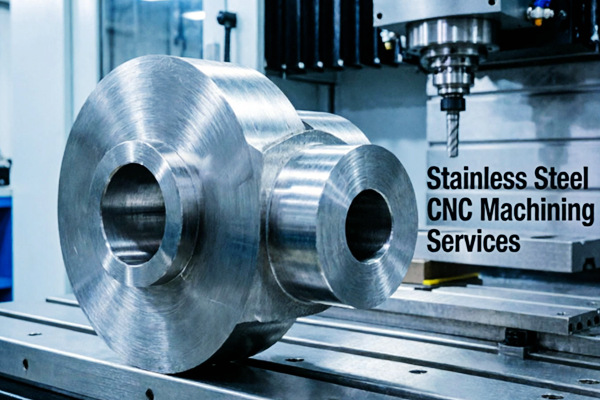
This is where the practical expertise of a seasoned machining service becomes invaluable. A competent provider does not simply accept a customer’s material choice at face value; they engage in a consultative dialogue. They ask: Will the component face cyclic loading in a saline environment? Does it require a mirror finish for aesthetic or hygienic reasons? Is the part a prototype destined for rapid iteration, or a high-volume production run demanding tool-life optimization? By guiding clients toward the optimal grade—be it the free-machining versatility of 303, the high-strength precipitation-hardening of 17-4 PH, or the duplex structure of 2205 for extreme chloride resistance—CNC services transform raw alloy potential into operational reality. This material-first approach reduces downstream failures, extends product lifecycles, and often lowers total cost of ownership, even when upfront bar stock prices appear higher.
Flexibility Beyond Geometry
The popular imagination often confines CNC machining to the production of static, identical parts. In truth, modern stainless steel CNC services are chameleonic in their capabilities. They cater to prototyping, where a single complex part may require five-axis simultaneous contouring and multiple tool changes; they also support mass production, where Swiss-type lathes produce thousands of miniature fasteners with tolerances held to±0.005 mm. This flexibility is not merely about batch size—it is about cross-industry adaptability.
Consider the divergent requirements of three typical clients: an aerospace contractor needs a lightweight, thin-walled 15-5 PH housing with intricate internal cooling channels; a dairy equipment manufacturer requires a 316L centrifugal pump impeller with a polished surface finish to prevent bacterial adhesion; and an oilfield services company demands a heavy-walled 410 stainless mandrel with coarse threads for high-torque downhole tools. The same machining service, equipped with multi-axis mills, live-tooling lathes, and wire EDM capabilities, can satisfy all three—not by changing its core technology, but by reprogramming toolpaths, adjusting cutting parameters (feeds, speeds, coolant pressure), and selecting appropriate carbide inserts with specialized coatings like TiAlN or AlCrN. This agility means that a single service provider can act as a long-term partner for a diverse client base, reducing the need for manufacturers to qualify multiple vendors for different material geometries.
Practical Considerations: Machinability and Post-Processing
No discussion of stainless steel CNC services is complete without addressing the practical elephant in the room: machinability. Stainless steels are notoriously gummy, work-hardening, and abrasive compared to aluminum or brass. This is where service providers earn their value through process intelligence. Advanced strategies—such as high-pressure coolant delivery through the spindle, trochoidal milling paths that minimize radial engagement, and adaptive clearing routines that maintain constant chip load—transform a potential machining nightmare into a routine operation. The practical outcome? Faster cycle times, longer tool life, and reliable surface integrity without micro-cracking or residual stress.
Equally critical is the post-machining ecosystem. Stainless steel CNC services often integrate secondary operations in-house or through trusted partners: passivation to restore the chromium oxide layer, electropolishing for ultra-smooth finishes, bead blasting for matte aesthetics, and even heat treatment for precipitation-hardening grades. This one-stop capability ensures that the flexible geometry produced by the CNC process is immediately service-ready, eliminating the logistical friction of outsourcing finishing steps. Furthermore, many providers now offer on-machine probing and automated dimensional reporting, ensuring that each flexible design iteration is backed by hard data—a practical necessity for industries regulated by ISO 13485 (medical) or AS9100 (aerospace).
Conclusion: A Partnership in Performance
Ultimately, stainless steel CNC machining services are far more than a transactional means to an end. They are a collaborative engine that merges material science with digital fabrication, delivering components that are as adaptable as the markets they serve. The true flexibility lies not in the machine’s axes, but in the service provider’s ability to navigate the nuanced alloy landscape, match grade to application, and optimize every cutting pass for economy and excellence. For engineers and procurement specialists, choosing such a service is an investment in practical reliability—one that ensures their stainless steel parts will not only fit the blueprint but also withstand the rigors of the real world. In an age of supply chain uncertainty and rising quality expectations, that combination of versatility and material wisdom is not just advantageous; it is indispensable.




