

SLS vs. SLA: Choosing the Right 3D Printing Technology for Your Project
When stepping into the world of advanced 3D printing, two acronyms dominate the professional landscape:SLS(Selective Laser Sintering) and SLA(Stereolithography). While both use lasers to transform raw materials into solid objects, they operate on fundamentally different principles. SLA cures liquid resin, while SLS fuses powder particles. Understanding these differences is crucial for engineers, designers, and hobbyists who need functional parts, not just plastic trinkets. Let’s break down the mechanics, materials, and practical applications of each technology.
The Core Mechanics: Powder vs. Liquid
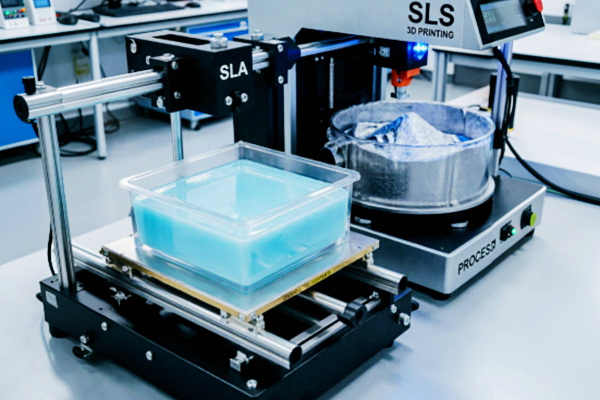
SLA is the elder statesman of 3D printing. It uses a precise ultraviolet laser to selectively cure a photosensitive liquid resin layer by layer. The build platform lifts the object out of a resin vat, exposing fresh liquid for the next pass. This allows for incredibly smooth surfaces and fine details.
SLS, on the other hand, skips the liquid entirely. A high-powered laser sinters (fuses) tiny particles of polymer powder together. The unfused powder surrounding the part acts as a natural support structure, meaning SLS can produce complex geometries, interlocking hinges, and moving components without any dedicated support scaffolding. This single difference—supports versus support-free—often dictates which technology you should use.
Material Properties and Durability
The materials used in each process lead to vastly different end results.
SLA Materials (Resins)
Standard resins are brittle and can degrade under UV light, but modern engineering resins have changed the game. Today, you can get high-temp resins, flexible resins (like rubber), and tough resins that mimic ABS. However, SLA parts are generally not suitable for outdoor, long-term use without special coating.
SLS Materials (Powders)
The most common material is Nylon (PA12). SLS produces dense, isotropic parts—meaning they are equally strong in all directions, unlike FDM or SLA parts which can be weak along layer lines. SLS nylon parts are durable, slightly flexible, heat-resistant, and chemically resistant. They are ideal for functional prototypes and end-use production parts.
Surface Finish and Accuracy
If visual aesthetics are your priority, SLA wins outright. The liquid resin can achieve layer heights as low as 25 microns, resulting in a glassy smooth finish that hides layer lines. This makes SLA the go-to for dental models, jewelry masters, and miniatures.
SLS parts have a distinctly different feel. They emerge from the printer with a slightly grainy, powdery texture (like sandstone). While you can tumble, dye, or vapor smooth SLS parts, they will never be as optically clear or glossy as SLA. However, SLS holds excellent dimensional accuracy for mechanical fits, such as snap-fit enclosures or assembly jigs.
Post-Processing Workflow
This is where many users underestimate the cost of ownership.
SLA
After printing, you must wash the part in isopropyl alcohol to remove uncured resin, then post-cure it in a UV chamber. You also have to manually remove support structures, which leaves small marks on the surface. The liquid resin is messy and toxic, requiring gloves and ventilation.
SLS
The workflow is cleaner but more industrial. When a print finishes, the entire powder cake must cool down for hours. You then use compressed air or a bead blaster to remove the unfused powder from the part. The good news: no supports to cut off. The bad news: you need expensive powder recovery systems to recycle unused material efficiently.
Cost and Scalability
For entry-level users,SLA is cheaper. Desktop SLA printers (like Formlabs or Anycubic) are affordable, and resin is relatively low-cost. However, large SLA prints require massive vats of resin.
SLS remains expensive. Desktop SLS units exist but start in the thousands of dollars. The nylon powder is costly, and you cannot reuse 100% of it (typically 50-70% fresh powder is required). For this reason, most businesses use SLS printing services rather than buying their own machine unless they are running high-volume production.
Which One Should You Choose?
Ask yourself two questions: What is the part for? and Does it need supports?
Choose SLA if:
· You need high detail, smooth surfaces, or transparency.
· You are making small figurines, jewelry, or dental aligners.
· You have the patience for washing and curing.
Choose SLS if:
· You need strong, durable, functional parts (nylon).
· Your design has internal channels, interlocking links, or complex overhangs.
· You want parts that snap, bend, or withstand heat.
· You are producing end-use parts or low-volume manufacturing.
The Bottom Line
SLA is a precision tool for form and aesthetics. SLS is an engineering tool for function and durability. Neither is universally "better"—but for real-world mechanical parts that must survive drop tests or engine bays, SLS nylon is the undisputed king. For visual prototypes that look like injection-molded plastic, SLA leads the pack. Understand your part’s lifecycle, and the choice becomes clear.




