

The Unrivaled Solution for Custom Plastic Prototypes-Silicone Molding
In the high-stakes world of product development, the journey from a digital 3D model to a physical, testable part is fraught with compromise. Engineers and designers often find themselves at a crossroads: invest heavily in steel tooling for production-grade parts, or settle for the material limitations of 3D printing. However, there is a "Goldilocks" solution that sits perfectly between the two extremes—a process that combines the material integrity of injection molding with the agility of rapid prototyping. This is the domain of Silicone Molding, also known as RTV molding, vacuum casting.
For the discerning product developer, silicone molding is not merely a prototyping technique; it is a strategic advantage. It allows for the production of plastic prototype parts that are functionally identical to final production components, offering a tangible, tactile experience that digital simulations can never replicate.
The Core Advantage: Functional Fidelity
The primary allure of silicone molding lies in its ability to replicate the "feel" of mass production. Unlike stereolithography (SLA) or fused deposition modeling (FDM), which build parts layer by layer—often resulting in anisotropic properties (where strength varies by direction)—silicone molding utilizes casting.
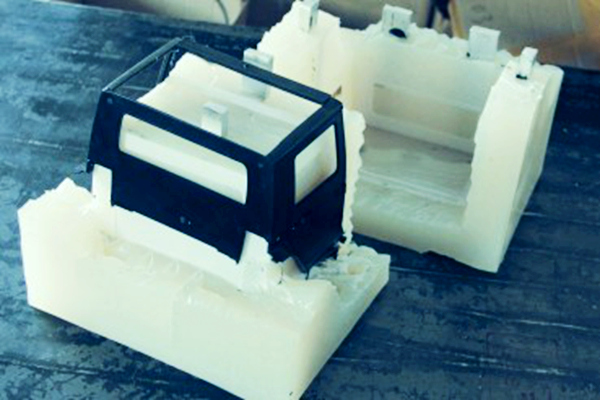
By using a flexible silicone mold as a negative, we inject liquid polyurethane or epoxy resins under vacuum. This process ensures that the resulting prototypes are 100% isotropic. They possess uniform strength, surface finish, and mechanical properties in all directions. This is critical for functional testing. Whether you are testing a snap-fit joint, a living hinge, or a pressure seal, a silicone-molded part behaves exactly like an injection-molded part, providing you with reliable data that 3D printed models often obscure.
Furthermore, the material library available for silicone molding is vast. We can mimic the specific characteristics of ABS, Polycarbonate (PC), Nylon, or even rubber-like elastomers. This means we don't just give you "a plastic part"; we give you a prototype that mirrors the specific flex modulus, heat deflection, and impact resistance of your specified production resin.
The Efficiency Engine: Navigating the "Bridge" to Production
Where silicone molding truly outshines its competitors is in its role as a bridge tooling solution. Traditional injection molding requires hardened steel or aluminum tools that take weeks or months to machine. The cost of a single modification to these tools can be devastating to a tight development budget.
Silicone molding turns this timeline on its head. A silicone mold can be produced from a master pattern (often 3D printed) in as little as 24 to 48 hours. This rapid turnaround allows development teams to iterate at the speed of thought. Need a design modification? We adjust the master pattern, pour a new silicone mold, and we are back to casting in a matter of days, not months.
This speed is nothing short of revolutionary for batch production of prototypes. While we cannot produce millions of parts in a silicone mold—the tool degrades after roughly 20 to 25 shots—we can efficiently produce 50 to 100 high-quality parts. This "medium-volume" capability is where the efficiency truly shines.
Batch Production without the Sticker Shock
Consider a scenario where you need 75 units for a focus group usability test or 100 units for regulatory compliance testing. If you were to use CNC machining, the cost per unit would remain high, as each part requires individual machine time. If you were to order steel tooling, the initial capital expenditure would be exorbitant for such a small run.
Silicone molding offers the perfect equilibrium. Once the silicone mold is created—an investment that is a fraction of steel tooling costs—the per-unit price drops dramatically. The process is essentially a low-pressure injection molding operation. Because silicone is flexible, it accommodates undercuts and complex geometries that would require complex, moving slides in a steel mold, further simplifying the process.
This flexibility ensures that customized processing is not a luxury but a standard. We can adjust colors, textures, and Shore hardness without disrupting the production workflow, providing unparalleled flexibility for variable testing.
Surface Finish and Aesthetics: Closing the Gap
Modern consumers demand perfection. A rough, layer-lined 3D print does not convey the premium feel of a consumer electronic device. Silicone molding excels here because it replicates the exact surface finish of the master pattern. If the master pattern is polished to a high-gloss "Class A" finish, every silicone-molded prototype will emerge with that same mirror-like shine. If the master has an EDM (Electrical Discharge Machining) spark texture, the silicone will reproduce it with micron-level accuracy.
This visual and tactile verisimilitude is crucial for design validation and marketing pre-production samples. It allows stakeholders to make decisions based on appearance and "fit and finish" long before the final production tooling is ever commissioned.
Conclusion: The Strategic Choice
In the competitive landscape of product manufacturing, time is currency, and accuracy is reputation. Silicone molding provides the bridge between the concept and the reality. It offers the material authenticity of injection molding with the low cost and speed of rapid tooling.
It is the process for the engineer who refuses to compromise, the designer who demands quality, and the business leader who understands that getting it right—with the right material and the right look—before committing to mass production is the ultimate key to success. When you need plastic prototypes that actually work, look, and feel like the real thing, silicone molding remains the most efficient, flexible, and professional choice in the industry.




