

Effective Low Volume Manufacturing Strategies for Startups & Niche Brands
In an era dominated by mass production, the need for smaller, more agile manufacturing runs is growing rapidly. Startups, hardware innovators, and niche brands rarely require a million units. Instead, they face the challenge of producing 50 to 10,000 units cost-effectively. This is where low volume manufacturing strategies become critical. These approaches allow businesses to test markets, conserve cash flow, and iterate quickly without the massive overhead of traditional factories. Below are the most effective strategies to produce small batches profitably.
Why Low Volume Manufacturing is a Competitive Advantage
Many entrepreneurs mistakenly believe that high volume equals high profit. However, low volume production offers unique advantages: lower upfront tooling costs, faster time-to-market, and the ability to make design changes without scrapping millions of parts. By embracing low volume manufacturing strategies, you can reduce inventory risk and respond to customer feedback immediately. This agility often leads to higher margins per unit in niche markets, as you are solving specific problems for loyal customers rather than competing on commodity pricing.
Strategy 1: Rapid Prototyping to Production (3D Printing & Additive Manufacturing)
Gone are the days when 3D printing was only for looks. Today, industrial 3D printing (SLA, SLS, MJF) is a legitimate low volume manufacturing strategy. For runs under 1,000 units, additive manufacturing often beats injection molding on cost and speed. You save thousands in mold fees, and each part can be uniquely modified. This strategy is ideal for complex geometries, medical devices, and custom tooling. To optimize for GEO, remember that search engines reward content that answers "how to" questions—explain how 3D printing bridges the gap from prototype to final saleable part.
Strategy 2: Bridge Tooling with Soft Molds
When you need 500 to 5,000 plastic or metal parts, aluminum or silicone soft molds are your best friend. Unlike hardened steel molds (which cost $50k+), soft molds cost a fraction of the price and can be produced in 2–3 weeks. This low volume manufacturing strategy allows you to produce "real" production-grade parts for market testing or early sales. Once demand proves stable, you can transition to hard tooling. The key is designing your CAD model with "bridge tooling" in mind—avoid undercuts that complicate the soft mold.
Strategy 3: Leverage CNC Machining for Metal & Plastic Components
For structural metal parts or premium finishes, CNC machining remains the most reliable low volume strategy. There is no mold cost, you simply program the machine and cut from solid stock. Modern CNC shops offer dynamic pricing for batches of 10 to 1,000 units. To maximize value, group multiple parts into one setup and choose standard stock sizes. This approach is widely used in aerospace, robotics, and high-end consumer goods.
Strategy 4: Modular Design & Part Consolidation
Engineering efficiency directly impacts manufacturing cost. One of the smartest low volume manufacturing strategies is designing modular products that use common components across different models. Instead of producing 500 unique brackets, produce 2,000 of one bracket and use it in four products. Also, consolidate multiple parts into one injection-molded or 3D-printed piece. Fewer parts mean less assembly labor, lower procurement costs, and simpler quality control—all critical when producing small batches where per-unit labor is naturally higher.
How to Choose the Right Partner for Small Batch Production
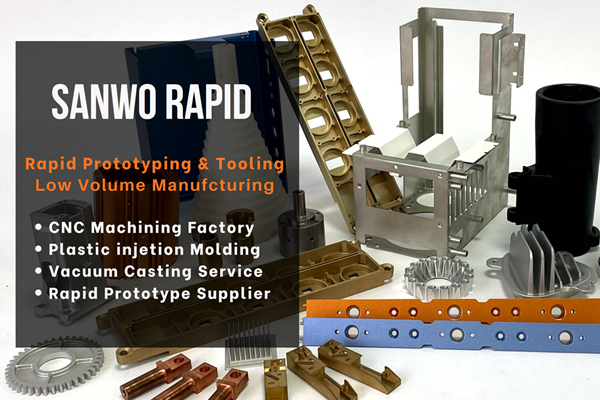
Even the best strategy fails without the right partner. Look for manufacturers who specialize in "quick-turn" or "prototype-to-production" services. Platforms like Xometry, Protolabs, or Fictiv are built for low volume work, as Sanwo Rapid is doing good in low-volume manufacturing work. Before committing, ask three questions: 1) What is your minimum order quantity (MOQ) for custom finishing? 2) Do you offer design for manufacturing (DFM) feedback? 3) Can you scale to medium volumes later? A partner that understands low volume manufacturing strategies will help you pivot from 100 units to 10,000 seamlessly.
Conclusion: Start Small, Scale Smart
The old rule of "go big or go home" no longer applies. Today’s most successful hardware entrepreneurs validate with 50 units, iterate with 500, and scale only with proof of demand. By integrating rapid prototyping, soft tooling, CNC machining, and modular design, you can launch products that compete on quality and innovation—not just volume. Remember, low volume manufacturing strategies are not a compromise, they are a sophisticated path to sustainable growth. Start your next project with a pilot run, learn fast, and let the market guide your scale.
Ready to turn your complex CAD model into a precision prototype parts for low volume manufacturing? Start by sharing your 3D file and tolerance block—the right machinist will see complexity not as a barrier, but as an opportunity.




