

Aluminium Custom Parts Sourcing Guide: Tolerances, Finishes, and Certifications
Aluminium custom parts have become indispensable across industries where weight reduction, corrosion resistance, and design flexibility are paramount. From aerospace brackets and automotive heat sinks to medical housings and consumer electronics enclosures, machined and fabricated aluminium components underpin modern product innovation. Unlike off-the-shelf stock shapes, custom aluminium parts are engineered to exact drawings, tolerances, and surface specifications—delivering fit, function, and performance that standard components cannot match. This article examines the metallurgical rationale for choosing aluminium, the manufacturing routes available, and practical guidance for sourcing high-quality custom parts.
Why Aluminium? Metallurgical and Commercial Rationale
Aluminium's density is roughly one-third that of steel, making it the default choice for weight-sensitive applications without compromising structural integrity. When alloyed and heat-treated, aluminium achieves impressive strength-to-weight ratios—6061-T6, for instance, offers yield strengths exceeding 275 MPa while remaining highly machinable. The naturally occurring oxide layer provides excellent atmospheric corrosion resistance, and anodizing can further enhance both durability and aesthetics.
Thermal and electrical conductivity are additional differentiators. Aluminium heat sinks and busbars are ubiquitous in power electronics and LED lighting because the metal dissipates heat efficiently and conducts electricity well. From a manufacturing standpoint, aluminium machines quickly, forms readily, and welds cleanly, which shortens cycle times and reduces tool wear. It is also highly recyclable, aligning with corporate sustainability targets and increasingly influencing procurement decisions.
Manufacturing Routes for Custom Aluminium Parts
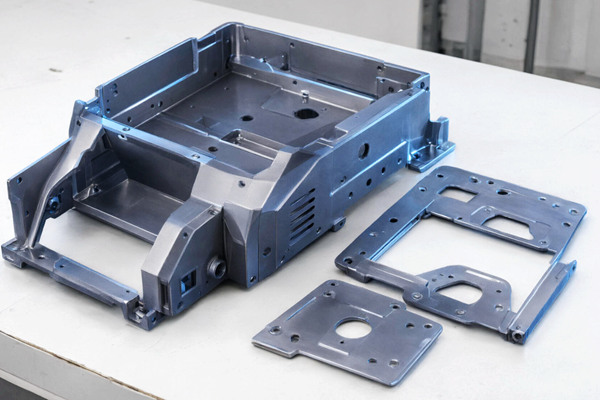
The appropriate process depends on geometry, volume, and tolerance requirements. CNC machining remains the workhorse for precision custom parts—three-, four-, and five-axis milling and turning deliver tight tolerances and excellent surface finishes, particularly suited to low-to-medium volumes and complex features. For higher volumes, aluminium die casting and permanent mold casting produce near-net shapes economically, though secondary machining is often required for critical interfaces.
Extrusion is ideal for constant cross-section profiles, such as frames, rails, and heat sink fins, and can be combined with machining for end features. Sheet metal fabrication—laser cutting, bending, and stamping—serves enclosures and brackets. Additive manufacturing is increasingly viable for prototypes and topology-optimized geometries that would be difficult to machine conventionally. Many projects combine routes: an extruded profile machined at the ends, or a casting finished with CNC operations.
Alloy Selection: Matching Material to Application
Alloy choice significantly affects performance and cost. The 6000 series (notably 6061 and 6082) offers an excellent balance of strength, machinability, weldability, and corrosion resistance—the default for general machined parts and structural components. The 7000 series (such as 7075) provides high strength for aerospace and high-stress applications but is less weldable and more prone to stress corrosion if improperly treated. The 2000 series (2024) is common in aerospace for its fatigue resistance, though it requires protective coating. The 5000 series excels in marine environments due to superior corrosion resistance, while the 1000 series is chosen for electrical conductivity. Casting alloys (A380, A356) dominate die-cast applications. Specifying the correct temper—T6, T651, O, or H32—is equally important, as temper governs strength, machinability, and dimensional stability.
Tolerances, Finishes, and Quality Assurance
Precision expectations must be communicated clearly. General machining tolerances of ±0.1 mm are common, while critical features can be held to ±0.01 mm or tighter. Surface finish specifications (Ra values) should reflect functional needs—sealing surfaces demand finer finishes than cosmetic panels. Common finishes include anodizing (Type II or hard Type III), powder coating, chromate conversion, bead blasting, and laser marking. For regulated industries, suppliers should provide material certificates, dimensional inspection reports, and First Article Inspection (FAI) documentation conforming to AS9102 for aerospace work.
Sourcing Considerations
When evaluating suppliers for aluminium custom parts, look beyond price. Confirm in-house machining capacity, alloy traceability, and experience with your industry's standards. Ask about design-for-manufacturability (DFM) feedback—reputable suppliers flag thin walls, deep pockets, and tolerance stack-ups before production. Clarify lead times for both prototyping and volume ramp, and verify quality certifications such as ISO 9001 or AS9100. Prototyping early with the intended production process reduces surprises later.
Conclusion
Aluminium custom parts combine lightweight strength, corrosion resistance, and manufacturability into a uniquely versatile solution. Success depends on three aligned decisions: selecting the right alloy and temper, choosing a manufacturing route matched to volume and geometry, and partnering with a supplier that provides transparent quality documentation and proactive engineering support. Companies that treat these choices as integrated rather than sequential consistently achieve better cost, performance, and time-to-market outcomes.




