

Revolutionizing Metal Casting-The Power of 3D Sand Printing
The manufacturing industry is undergoing a digital and green transformation, with 3D printing technology leading a paradigm shift in traditional foundry practices. By integrating 3D Sand Printing (3DP) with established casting processes, manufacturers can now achieve unprecedented levels of design freedom, production speed, and efficiency for complex metal parts.
This article explores how this innovative combination is setting new standards in the casting industry.
Core Advantages of 3D Sand Printing for Casting
The fusion of 3D Sand Printing and casting delivers transformative benefits that address key challenges in traditional manufacturing:
-
Unmatched Design Freedom & Complexity: This technology eliminates the need for expensive and time-consuming physical tooling (molds). It enables the direct digital fabrication of sand molds and cores, allowing for the production of parts with complex internal channels, large thin-walled structures, and integrated geometries that are impossible or prohibitively expensive with conventional methods.
-
Drastically Reduced Lead Times: By bypassing the tooling stage, the path from a digital CAD model to a functional metal casting is shortened from weeks or months to just days. This is ideal for prototyping, research & development trials, and low-volume production.
-
Cost-Effective for Small Batches: The economics of producing one part or one hundred parts become viable, as costs are no longer amortized over high-volume tooling. Design modifications can be made instantly in the digital file and printed in the next iteration with minimal cost impact.
-
Greener and Smarter Manufacturing: The process is inherently more material-efficient, reduces energy consumption compared to traditional pattern shops, and significantly improves the factory floor environment by lowering dust, noise, and labor intensity.
Two Dominant Process Combinations
Two primary 3D printing technologies have proven highly effective for sand casting applications:
-
Binder Jetting (3DP) for Sand Molds: This process uses a print head to selectively deposit a liquid binding agent onto layers of foundry sand (such as silica or zircon sand). It builds the mold layer by layer, capable of creating large-scale, high-strength molds with intricate cores in a single piece. It's perfectly suited for casting metals like iron, steel, and aluminum.
-
Selective Laser Sintering (SLS) for Investment Casting Patterns: While not for sand molds directly, SLS is used to print investment casting patterns from specialized casting wax or polystyrene. These precise patterns are then used in the traditional "lost-wax" process to create ceramic shells for casting superalloys, titanium, or other metals requiring exceptional surface finish and detail.
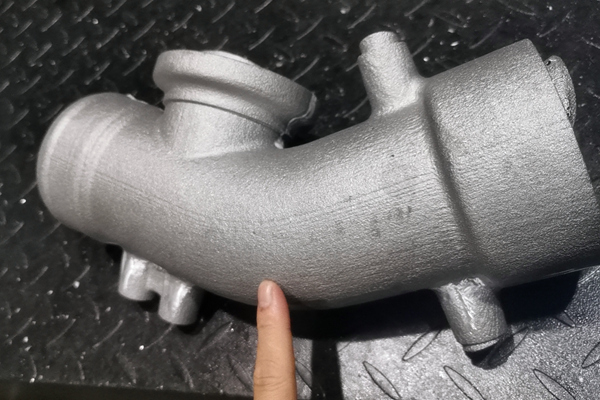
Industry Applications & Real-World Impact
This technology is no longer a laboratory experiment but a production-ready solution driving innovation across heavy industries.
-
Aerospace & Defense: Used to manufacture large-scale, lightweight structural components and complex engine parts with integrated cooling channels, where performance outweighs traditional cost barriers.
-
Automotive & Transportation: Enables the production of lightweight chassis components, complex engine blocks/cylinder heads, and large thin-walled housings for new energy vehicles, accelerating design iteration.
-
Energy & Heavy Machinery: Ideal for creating large, pressure-resistant casings, pump housings, and turbine components with complex internal geometries that are critical for performance.
-
Art & Large-Scale Sculptures: Provides artists and foundries the freedom to create intricate, large metal sculptures without the constraints of manual mold-making, turning digital art directly into bronze or aluminum.
The Integrated Production Model: From File to Finished Part
Leading providers are moving beyond selling just printers to offering complete, integrated solutions. A successful model involves:
-
Digital Design & Simulation: Optimizing the part and mold design for castability and performance using advanced software.
-
3D Sand Printing: Fabricating the precise sand mold or core assembly directly from the digital file.
-
Traditional Casting: Using the printed molds in standard foundry processes—such as low-pressure casting, gravity casting, or vacuum casting—to pour the molten metal.
-
Post-Processing & Machining: Conducting standard foundry operations like shakeout, heat treatment, and CNC machining to achieve the final dimensional tolerances and surface finish.
This integrated "3D Printing + Casting" workflow ensures quality control, consistency, and provides a one-stop service for clients from design to delivery.
The Future is Digital, Green, and Efficient
The adoption of 3D sand printing in foundries represents a core component of the smart factory and Industry 4.0 evolution. It aligns with global initiatives for greener manufacturing by reducing waste and energy use.
As printer build volumes increase, materials diversify, and process speeds improve, this technology is poised to move from primarily serving rapid prototyping and low-volume applications to becoming a complementary pillar in mainstream, high-mix production environments. It empowers the casting industry to be more agile, innovative, and competitive in a market demanding greater customization and faster time-to-market.
For any manufacturer or designer working with metal components, exploring the potential of 3D sand printing with casting is a strategic step towards future-proofing your production capabilities.
Looking to integrate this technology into your workflow?
Contact our team of experts to discuss your specific project requirements and discover how 3D sand printing can optimize your prototyping and production cycles.




